
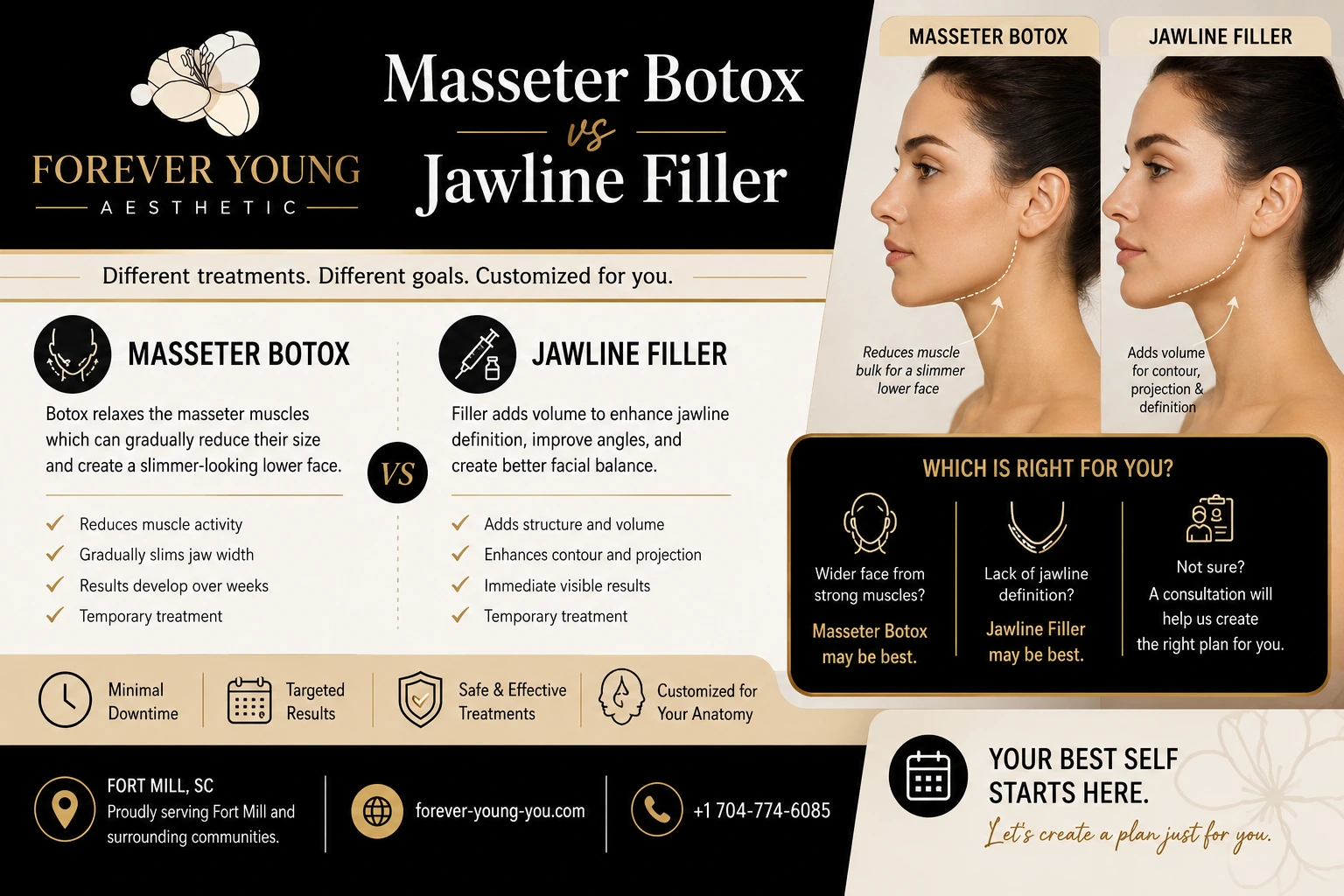
If you want to change the appearance of your lower face, both masseter Botox and jawline filler may come up during your research. Although they are both injectable treatments, they work in very different ways.
Masseter Botox is generally used to reduce the activity and bulk of the masseter muscles over time, while jawline filler adds volume to improve contour, projection, and definition. Botulinum toxin can be used cosmetically in thick jaw muscles, while dermal fillers are designed to add volume and enhance facial contours.
At Forever Young Aesthetic, we believe the right choice depends on what is creating the appearance you want to change. A wider lower face caused mainly by prominent masseter muscles requires a different approach than a jawline that lacks structural definition.
Neither treatment is automatically better. Your facial anatomy, muscle size, bone structure, skin quality, facial fat, and aesthetic goals all matter.
Botox or Filler? Get Expert Guidance
Find out which option best fits your features and aesthetic goals. Call today to schedule your consultation.
What Is the Difference Between Masseter Botox and Jawline Filler?
The simplest difference is muscle reduction versus structural enhancement.
Masseter Botox uses botulinum toxin to temporarily reduce activity in the masseter muscles, which are located along the sides of the jaw and play an important role in chewing. When those muscles are prominent, relaxing them can gradually make the lower face appear slimmer in appropriate candidates. The American Society of Plastic Surgeons notes that botulinum toxin treatment of the masseter can slim the lower face and jaw.
Jawline filler takes the opposite approach. Rather than reducing tissue, filler adds volume.
Depending on facial anatomy and treatment goals, filler may be used to:
- Make the jawline appear more defined
- Improve visible angles along the lower face
- Add projection
- Create a stronger transition between the face and neck
- Improve facial balance
Dermal fillers are injectable medical devices used to restore or add volume in specific facial areas.
So if your primary concern is excess muscle width, masseter Botox may make more sense. If your primary concern is limited structure or definition, jawline filler may be more appropriate.
What Does Masseter Botox Do?
The masseter is a strong muscle used when chewing and clenching your jaw.
Some people naturally have larger masseter muscles. Others may develop more prominent muscles because they frequently clench or use them heavily.
Botulinum toxin temporarily reduces nerve signals to the treated muscle, which decreases its ability to contract as strongly.
When used in prominent masseter muscles for cosmetic purposes, that reduction in activity can gradually reduce their visible bulk.
For the right patient, this may create:
- A narrower-looking lower face
- Less visual width through the jaw
- A softer transition from the cheek to jaw
- A less square-looking facial shape
Masseter Botox does not remove facial fat.
If the width of your lower face comes primarily from fat, bone structure, loose skin, or another anatomical feature, relaxing the masseter muscles may not produce the change you are expecting.
That is why determining what is actually contributing to facial width is an important part of the consultation.
What Does Jawline Filler Do?
Jawline filler adds volume rather than reducing muscle size.
A provider may use filler to enhance certain parts of the jawline where additional structure could improve balance or definition.
For example, filler may help someone whose jawline appears:
- Soft
- Recessed
- Poorly defined
- Asymmetrical
- Less angular than desired
The American Society of Plastic Surgeons notes that dermal filler can be used around the jaw and chin to create a more sculpted or defined appearance.
Jawline filler can make the border of the jaw more visible, but it does not physically shrink the width of the lower face.
In fact, because filler adds volume, it may increase dimensions in certain areas. The goal is generally to place that volume in a way that improves proportion and contour.
This distinction becomes especially important for patients who say they want a “slimmer jawline.” Sometimes what they really want is a sharper jawline, which may require a different strategy than reducing facial width.
Is Masseter Botox or Jawline Filler Better for Facial Slimming?
For actual visual slimming caused by large masseter muscles, masseter Botox is generally the more relevant treatment.
Because Botox reduces muscle activity, prominent masseters may gradually become less bulky. The result can be a narrower appearance through the lower face.
Jawline filler does not reduce muscle, bone, or fat.
Instead, it adds structure.
That means filler may sometimes make a face look more sculpted or balanced without actually making it narrower.
For example, improving chin projection or defining the jaw border can change the perceived proportions of the face. Someone may describe the final appearance as “slimmer” because the jawline looks sharper, even though volume was added.
The most important question is therefore not simply, “Which treatment makes the face slimmer?”
It is:
What is causing the lower face to look wider or less defined in the first place?
If the answer is primarily muscle, Botox may be appropriate. If the issue is limited skeletal definition, filler may provide more benefit.
Which Treatment Is Better for Jawline Definition?
Jawline filler is generally the more direct choice when the goal is stronger visible definition.
Filler can add volume exactly where greater contour or projection is desired, creating a more noticeable jaw border.
Masseter Botox can also affect the appearance of the jawline, but indirectly.
By reducing excess muscle bulk, Botox may make existing facial structure easier to see. However, it does not build or strengthen the jawline itself.
Imagine two different concerns:
One patient has a strong underlying jaw but very prominent masseter muscles that make the lower face look wide. Reducing muscle bulk may reveal more of their natural contour.
Another patient has relatively small masseters but lacks visible jawline projection. Reducing those muscles would not create the missing structure. Filler may be more suitable.
This is why treatment should be based on anatomy instead of simply choosing whichever injectable is currently more popular.
How Do the Treatment Experiences Compare?
Both treatments are typically performed through a series of injections after an aesthetic consultation.
Before either procedure, your provider should evaluate your facial anatomy, medical history, goals, and whether the treatment is appropriate for you.
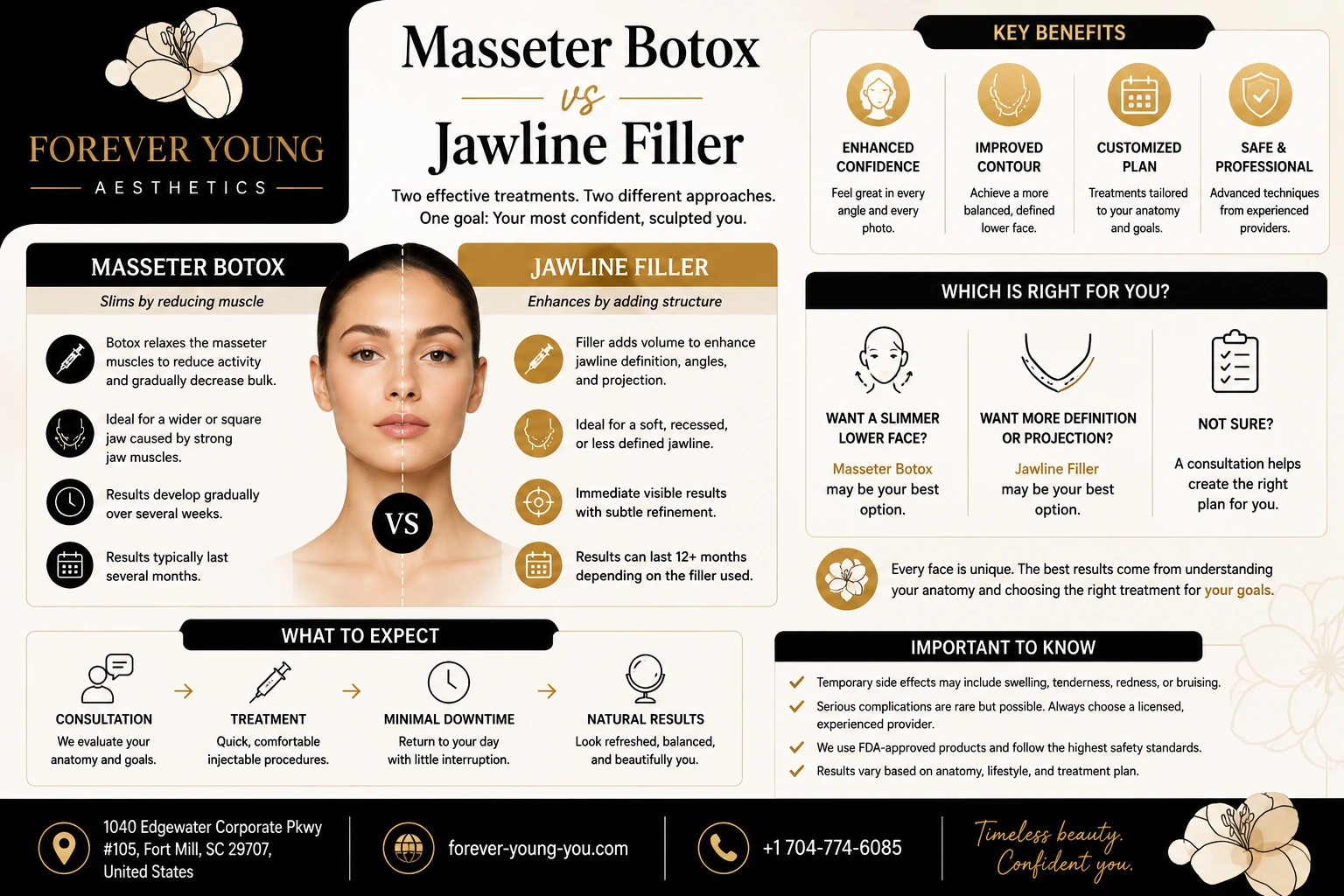
Masseter Botox
Treatment involves injecting botulinum toxin into the targeted masseter muscles.
There is typically little downtime, although temporary tenderness, swelling, or bruising can occur.
Because the masseter is involved in chewing, treatment must be approached thoughtfully. Temporary changes in how the jaw feels or functions can occur, and individual responses vary.
Jawline Filler
Jawline filler involves injecting dermal filler into selected areas of the lower face.
The result may be noticeable fairly quickly, although swelling can temporarily affect how the jawline looks immediately after treatment.
Common temporary reactions to dermal filler include swelling, tenderness, redness, bruising, itching, and discomfort.
Both procedures are medical treatments and should be performed by appropriately qualified professionals.

Best Dermal Fillers for Nasolabial Folds: Which One Works Best?
Do you notice smile lines or nasolabial folds making you look older than you feel? If you’re searching for the…

How Long Does It Take to See Results?
This is one of the biggest differences when comparing masseter Botox vs jawline filler.
Masseter Botox Results Are Gradual
Botulinum toxin does not instantly reduce the size of the masseter muscle.
Muscle activity begins to decrease first. Changes in visible muscle bulk develop more gradually afterward.
This means you should not expect to walk out of your appointment with a dramatically narrower jaw.
The appearance evolves as the muscle responds over time.
Jawline Filler Results Are More Immediate
Filler adds physical volume during treatment, so changes in contour can often be seen immediately.
However, what you see right after treatment is not necessarily the final result.
Temporary swelling or tenderness may make the area appear different during the early recovery period. Once that resolves, the jawline can be evaluated more accurately.
If you want gradual reduction, Botox and filler behave very differently. If immediate structural enhancement is the goal, filler generally produces a more immediate visible change.
How Long Do Masseter Botox and Jawline Filler Results Last?
Neither treatment should be considered permanent.
Botulinum toxin gradually wears off as muscle activity returns. How long the aesthetic effect remains noticeable can vary according to the individual, treatment history, metabolism, muscle activity, and other factors.
Jawline filler also gradually changes over time.
Duration depends heavily on the specific filler product used, treatment area, individual metabolism, and the amount of movement in the area. Some fillers used for facial contouring may remain visible for a year or longer, but exact longevity should be discussed according to the specific product selected. The American Society of Plastic Surgeons notes that certain fillers used around the jaw and chin may last approximately one to two years.
Rather than selecting a treatment solely based on which one lasts longer, it is more important to determine which treatment actually addresses your anatomy.
A long-lasting treatment that targets the wrong concern will not provide the result you wanted.
Can Masseter Botox and Jawline Filler Be Used Together?
Yes, they can sometimes complement one another.
Botulinum toxin and dermal fillers may be used as part of the same broader cosmetic treatment strategy when appropriate.
For example, someone may have:
- Prominent masseter muscles creating excessive width
- Limited jawline projection
- A chin that could benefit from additional structural balance
In that situation, reducing muscle bulk and enhancing structure are two separate goals.
Masseter Botox could address the muscular component while filler improves contour.
However, combination treatment is not necessary for everyone.
Some patients may achieve their desired result with Botox alone. Others may need only filler. Still others may have concerns related more to skin laxity, facial fat, or underlying bone structure, which can change the recommended approach entirely.
More treatment does not automatically mean a better result.
How Do You Decide Which Treatment Is Right for You?
The first step is identifying what you actually want to change.
If your main concern is a wide or square-looking lower face, ask what is creating that width.
It could be:
- Large masseter muscles
- Natural bone structure
- Facial fat
- Skin laxity
- A combination of factors
If prominent masseter muscles are the primary cause, Botox may help create a slimmer appearance.
If your concern is a soft or poorly defined jawline, filler may provide the structural enhancement you want.
Your overall facial proportions matter as well.
A treatment that looks balanced on one person may not create the same effect on another because the chin, cheeks, jaw, neck, skin, and facial width all interact visually.
At Forever Young Aesthetic, our goal is to evaluate the lower face as a whole rather than assuming every patient needs the same injectable treatment.
What Fort Mill Patients Should Know Before Treatment
If you are considering masseter Botox or jawline filler in Fort Mill, consultation should come before deciding which treatment you want.
Photos on social media can make injectables seem interchangeable, but facial anatomy is highly individual.
During your consultation, your provider should consider:
- The size and activity of your masseter muscles
- Your natural jaw and chin structure
- Facial width and proportions
- Skin quality and laxity
- Facial fat distribution
- Symmetry
- Your desired outcome
- Your medical history
Safety should also be part of the discussion.
Dermal filler commonly causes temporary swelling, redness, tenderness, pain, or bruising. Rare but serious complications can occur if filler unintentionally enters a blood vessel, including tissue injury, vision problems, and stroke. The FDA therefore recommends choosing a licensed healthcare provider with appropriate experience and training.
Botulinum toxin treatments also have potential side effects and should be performed by qualified professionals familiar with facial anatomy.
At Forever Young Aesthetic, we believe the best treatment decision starts with determining whether your concern is primarily related to muscle bulk, structural definition, or another part of your facial anatomy.
That distinction can make the choice between masseter Botox and jawline filler much clearer.
FAQs
Is masseter Botox better than jawline filler?
Neither is universally better. Masseter Botox primarily reduces muscle activity and can gradually decrease visible jaw muscle bulk. Jawline filler adds volume to improve structure and definition. The better option depends on your anatomy and goals.
Can masseter Botox make my face look slimmer?
It can in appropriate candidates whose lower-face width is significantly influenced by enlarged masseter muscles. It does not remove facial fat or change the underlying jawbone.
Does jawline filler make your face slimmer?
Jawline filler does not physically reduce facial width because it adds volume. However, improved contour and projection may make the lower face appear more balanced or defined.
Which gives a sharper jawline, Botox or filler?
Filler is generally more direct for adding jawline definition because it enhances structure. Botox may improve the appearance of an existing jawline when excessive masseter bulk is obscuring its natural shape.
Is jawline filler immediate?
The structural change from filler can usually be seen soon after treatment, although temporary swelling may affect the initial appearance.
How quickly does masseter Botox work?
Muscle activity changes gradually, and visible slimming takes additional time because the muscle must decrease in bulk. Results are therefore not immediate.
How long does masseter Botox last?
Results are temporary and vary by patient. Muscle activity eventually returns, and maintenance treatment may be considered depending on your response and goals.
How long does jawline filler last?
Longevity depends on the filler product, individual metabolism, treatment location, and other factors. Some fillers used for facial contouring may remain noticeable for a year or longer.
Can you get masseter Botox and jawline filler together?
Yes, in some cases. Botox may reduce excessive muscle width while filler enhances structural definition. A consultation can determine whether using both treatments would provide a meaningful benefit.
Can masseter Botox affect chewing?
Because the masseter muscles are involved in chewing, temporary changes in muscle strength or how the jaw feels can occur. This is one reason careful patient selection and professional treatment are important.
Will masseter Botox change my facial width?
It may reduce the visible width of the lower face if prominent masseter muscles are a major contributor. It will not significantly change width caused by bone structure or facial fat.
Why is consultation important before choosing between Botox and filler?
A wide jaw, weak jawline, or poorly defined lower face can be caused by muscle size, bone structure, fat distribution, skin laxity, or several factors together. A professional assessment helps determine which anatomical feature should actually be treated.
Ready for a More Sculpted Jawline?
Get a professional consultation and discover which treatment can deliver the look you want.