

Facial massage after fillers is not something patients should automatically begin on their own. In the early recovery period, unnecessary rubbing, pressing, or manipulating treated areas may worsen swelling or interfere with healing. However, certain filler products have specific aftercare instructions that may include provider-directed massage.
The right advice depends on the filler used, the treatment area, your injector’s technique, and how you are healing. At Forever Young Aesthetics, we recommend following the instructions given at your appointment rather than applying a general massage rule to every type of dermal filler.
Can You Massage Your Face After Fillers?
Not immediately unless your injector specifically tells you to.
Dermal fillers are injectable medical devices placed within or beneath facial tissues. Following treatment, it is common to experience temporary swelling, tenderness, redness, or bruising. The FDA lists all of these among recognized filler side effects.
Because the area has recently been injected, aggressively rubbing or massaging it is generally unnecessary.
The American Society of Plastic Surgeons advises avoiding aggressive massage after facial filler because significant pressure could potentially contribute to filler movement. It also recommends avoiding pressure on recently treated areas while they heal.
However, this does not mean massage is forbidden after every filler treatment.
Some filler products have very different aftercare protocols. Certain products may actually require massage to help distribute the material appropriately. That is why the name of the filler and your injector’s instructions matter.
Unless you were specifically shown how to massage a treated area, do not begin manipulating it because you notice swelling, firmness, or asymmetry.
Contact your injector first.
Why Should You Avoid Pressure Right After Filler Treatment?
The tissue around an injection site has experienced minor trauma.
Even with careful injection techniques, temporary effects may include:
- Swelling
- Bruising
- Redness
- Tenderness
- Mild discomfort
- Temporary firmness
- Small palpable areas around injection sites
The American Society of Plastic Surgeons notes that the initial appearance after filler can include swelling, bruising, numbness, redness, and palpable lumps or hard areas.
Pressing aggressively on an already swollen or tender area can make it more uncomfortable.
Strong pressure may also be unnecessary while the filler and surrounding tissue are settling.
Be mindful of pressure from more than just your hands. Early after treatment, pressure could also come from:
- A professional facial massage
- Sleeping directly on a treated cheek
- Massage-table face cradles
- Tight facial equipment
- Firm skincare tools
- Facial rollers or gua sha
- Aggressive makeup application
- Repeatedly checking a lump by pressing on it
ASPS specifically advises avoiding massage-table pressure for about 24 to 48 hours after filler as a general precaution, although your own injector may use a different timeframe.
How Long Should You Wait Before Facial Massage?
There is no universal waiting period that applies to every filler patient.
Your appropriate timeline can depend on:
- Which filler was injected
- Where it was placed
- How much product was used
- Your level of swelling or bruising
- Whether another procedure was performed
- Your injector’s technique
- Product-specific aftercare instructions
As a general example, the American Society of Plastic Surgeons recommends avoiding massage-table pressure for roughly 24 to 48 hours after facial filler.
That should not be interpreted as meaning everyone is automatically cleared for a deep facial massage once 48 hours have passed.
A vigorous lymphatic massage, sculpting facial treatment, or deep-tissue facial technique may involve substantially more manipulation than ordinary washing or skincare.
If you have an upcoming facial, massage, spa treatment, dental appointment, or other procedure that will place pressure on your face, tell your injector. They can advise you about timing based on what was actually injected.
If your face remains significantly swollen, tender, or bruised, it may be sensible to postpone unnecessary facial manipulation until your provider confirms that recovery is progressing normally.
Can Massage Move or Affect Dermal Filler?
Aggressive manipulation may potentially affect recently placed filler, but the subject is more nuanced than the common claim that simply touching your face will immediately “move” filler.
The FDA recognizes filler migration, meaning movement away from the injection site, as a rare reported complication.
However, ordinary activities such as gently washing your face are very different from repeatedly kneading, pressing, or aggressively massaging a newly treated area.
The American Society of Plastic Surgeons recommends avoiding aggressive massage after filler because it could potentially contribute to migration.
At the same time, some fillers are deliberately massaged during treatment by the healthcare professional.
For example, official JUVÉDERM Ultra instructions tell clinicians that after injection, the treated area may be gently massaged so that the product conforms to the surrounding tissue.
That does not mean patients should replicate the technique at home.
Your injector knows where the filler was placed, how deeply it was injected, how much was used, and whether any manipulation is appropriate.
Do not attempt to “fix” a result by pushing filler into another position yourself.
Is Lip Massage Different From Facial Massage?
Lip filler deserves particular care because the lips can swell considerably following injections.
Swelling can temporarily make the lips feel:
- Firm
- Uneven
- Lumpy
- Tender
- Larger on one side than the other
Those sensations can make patients want to press or massage the lips to make them feel smoother.
Avoid doing so unless your injector specifically instructs you.
Early swelling can create temporary irregularities that improve as inflammation subsides. Manipulating the area before your injector has assessed it may make it harder to distinguish normal recovery from something that actually requires attention.
Different lip fillers also have different properties and aftercare recommendations.
If you feel a lump, do not repeatedly squeeze it to determine whether it is still there. Instead, contact your injector if the area is painful, increasingly firm, persistent, or concerning.
Gentle actions such as eating, drinking, and ordinary facial movement are different from deliberately massaging the lips.
Follow the instructions given for the specific filler placed in your lips.
When Might a Provider Recommend Gentle Massage?
There are situations in which massage is appropriate, but it should be based on the product and treatment plan.
Some injectable products specifically require post-treatment massage.
A good example is Sculptra, an injectable poly-L-lactic acid collagen stimulator. Its official instructions recommend massage after treatment to help distribute the product evenly. Patients may be instructed to massage the treated area for five minutes, five times daily, for five days, according to their healthcare professional’s advice.
This is very different from assuming the same rule applies to every filler.
Product-specific guidance can even vary within the same manufacturer’s portfolio. Galderma’s patient guidance, for example, recommends massage after Sculptra while advising against massage of areas treated with certain Restylane products.
Your injector may also perform gentle manipulation during the procedure or recommend a specific technique later if an area needs professional management.
If massage is recommended, ask:
- Exactly where should I massage?
- How much pressure should I use?
- How long should each session last?
- How often should I do it?
- When should I stop?
- What symptoms mean I should call instead of massage?
Never substitute an online massage technique for instructions from the professional who performed your treatment.
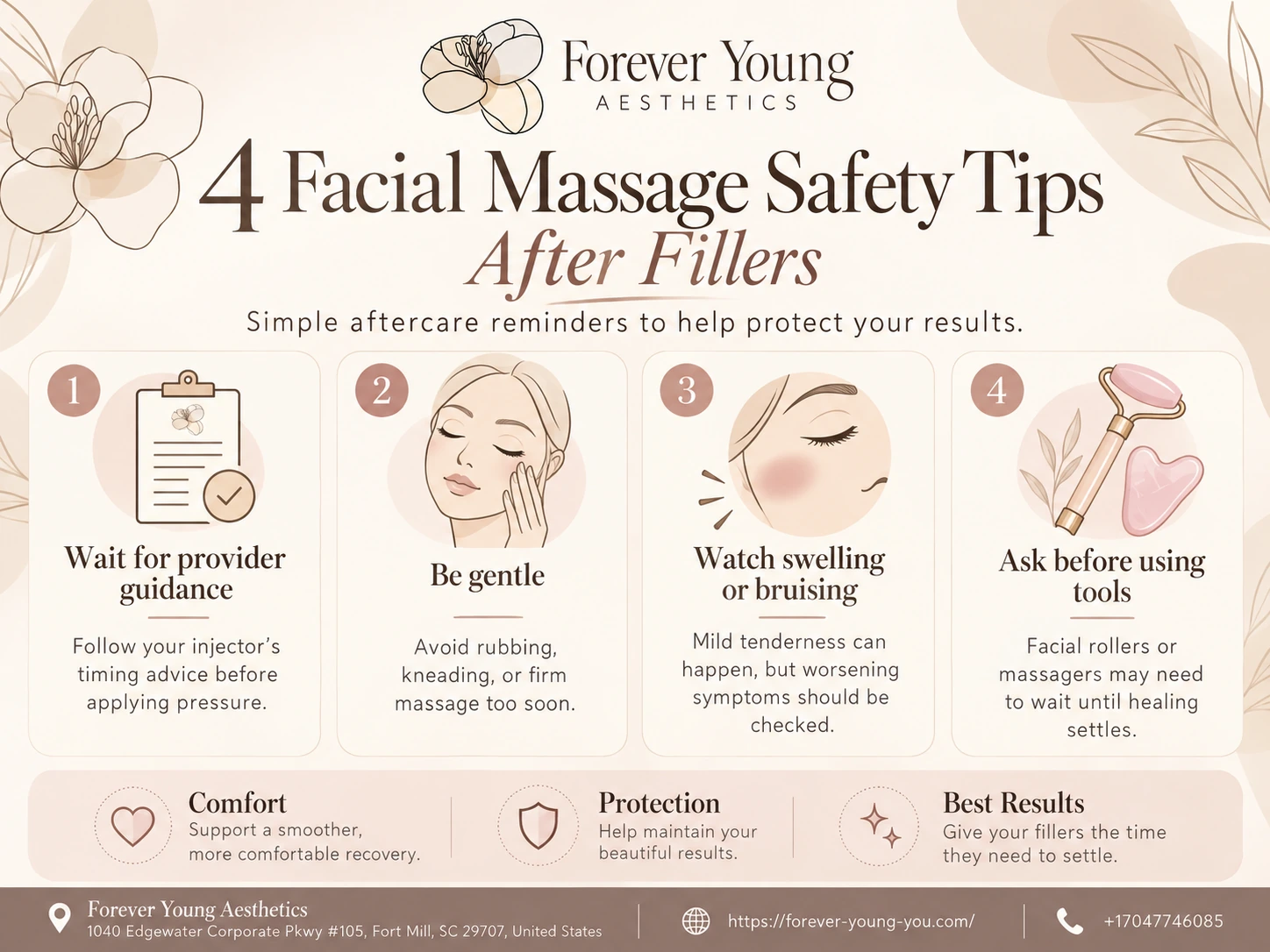
What Types of Facial Treatments Should You Avoid After Fillers?
Immediately scheduling another facial treatment after fillers may expose the treated areas to unnecessary pressure, heat, or irritation.
Depending on what you had injected, your provider may advise temporarily postponing:
- Facial massage
- Gua sha
- Facial rollers
- Deep-tissue facial treatments
- Lymphatic facial massage
- Microcurrent treatments
- Aggressive exfoliation
- Certain facials
- Treatments involving strong suction
- Procedures involving prolonged pressure on the face
ASPS advises avoiding significant pressure and aggressive massage following filler treatment and also recommends temporarily limiting excessive heat and strenuous exercise because they can contribute to swelling or bruising.
Product instructions may add other restrictions.
For example, official JUVÉDERM guidance recommends avoiding strenuous exercise and extensive sun or heat exposure during the first day after treatment because these may temporarily worsen redness, swelling, or itching.
If you regularly schedule facials, massage therapy, chiropractic care, dental work, or other treatments that involve pressure against the face, mention that when booking your filler appointment.
Spacing treatments appropriately can make recovery easier.
How to Care for Your Face During Filler Recovery
Filler recovery generally does not require an elaborate routine.
The most useful approach is often to leave the treated areas alone and follow the instructions your injector gave you.
Keep cleansing gentle
Wash your face without vigorous rubbing, scrubbing, or repeatedly pressing on injection sites.
Pat the skin dry rather than dragging a towel across tender areas.
Do not repeatedly check the filler
It can be tempting to touch your cheeks or lips throughout the day to see whether swelling has changed.
Try to avoid doing this.
Swelling, firmness, and mild irregularities can be part of early recovery. Repeatedly pressing on them does not help them settle.
Follow instructions about cold packs
A cold pack may be recommended for temporary swelling following certain filler treatments. ASPS notes that topical icing can help with common initial reactions.
If your provider recommends it, wrap the cold pack appropriately rather than placing ice directly against your skin, and avoid pressing firmly.
Limit strenuous exercise when advised
ASPS generally recommends avoiding intense physical activity during the first 24 to 48 hours to help minimize bruising and swelling. Your injector may provide a different timeline.
Avoid unnecessary heat
Saunas, very hot environments, and other sources of excessive heat may aggravate temporary swelling after treatment. Follow your provider’s instructions before returning to them.
Sleep carefully
Your provider may recommend avoiding unnecessary pressure directly against newly treated areas while sleeping.
You do not need to remain perfectly still all night, but deliberately sleeping with a newly treated cheek pressed firmly into a pillow may not be ideal during early recovery.
Give the result time
What you see immediately after injections is not necessarily the final result.
Swelling can temporarily change facial symmetry and volume. Allow recovery to progress before deciding whether an area requires correction.
When Should You Contact Your Injector?
Contact your injector if you are unsure whether something you are experiencing is normal rather than attempting to massage the area yourself.
The FDA lists swelling, bruising, tenderness, redness, and pain among common filler reactions, many of which resolve within days to weeks.
However, worsening or unusual symptoms should be evaluated.
Contact your provider if you notice:
- Increasing rather than improving swelling
- Significant or unusual pain
- Increasing redness or warmth
- A persistent or painful lump
- Drainage or signs of infection
- Sudden or significant asymmetry
- Skin changes around the injection site
- Any reaction that concerns you
Some filler complications require urgent medical attention.
The FDA advises seeking immediate medical care for unusual pain, vision changes, or skin near the injection site becoming white, gray, or blue. Symptoms suggestive of a stroke, including sudden weakness, difficulty speaking, facial drooping, severe headache, confusion, or difficulty walking, also require immediate medical attention.
Do not attempt to massage through severe pain, discoloration, or visual symptoms.
Those are not problems that should be managed through home massage.
FAQs
Can I use a facial roller after filler?
It is best to wait until your injector clears you. Facial rollers deliberately place pressure on the skin, so using one immediately after filler may unnecessarily manipulate swollen or recently injected tissue.
Can I use gua sha after dermal fillers?
Avoid restarting gua sha without checking with your injector. Gua sha often involves repeated pressure and sweeping motions across the face, which may not be appropriate during early filler recovery.
What happens if I accidentally massage my face after fillers?
A brief accidental touch or gentle contact does not automatically mean your filler has moved. Stop deliberately massaging the area and continue following your aftercare instructions. If significant pressure was applied or the treated area changes in a way that concerns you, contact your injector.
Should I massage lumps after lip filler?
Do not automatically massage a lump yourself. Temporary swelling or firmness may occur after lip filler, but your injector should determine whether an area needs observation, massage, or another form of treatment.
Can I get a professional facial after fillers?
Eventually, yes, but timing depends on the filler, treatment location, type of facial, and your recovery. Tell both your injector and aesthetician about your filler treatment before scheduling anything involving massage, pressure, heat, or facial devices.
Why did my injector tell me to massage when other advice says not to?
Different injectable products require different aftercare. Some products, such as Sculptra, include specific massage instructions, while certain other fillers may be managed without massage. Always follow the instructions for the product you actually received.
Caring for Fillers at Forever Young Aesthetics
When it comes to facial massage after fillers, the safest approach is not to assume that every injectable should be treated the same way. Some fillers are best left relatively undisturbed during early recovery, while certain products come with specific provider-directed massage instructions.
At Forever Young Aesthetics, we want patients to understand exactly what to do after treatment. Before leaving your appointment, make sure you know whether you should avoid massage completely, whether any specific manipulation is recommended, and when you can return to facials, gua sha, rollers, massage therapy, or other treatments.
If you notice a lump, unusual swelling, tenderness, or asymmetry after filler, contact us rather than trying to reshape or massage the area yourself. Your injector can determine whether what you are seeing is part of normal recovery or something that needs further evaluation.
Individual aftercare instructions should always take priority over generalized filler advice.