

The best treatments for neck lines depend on what is causing them. Horizontal creases, fine wrinkles, sun-damaged skin, laxity, and muscle-related neck bands can look similar at first, but they do not always respond to the same treatment.
Some patients may benefit from Botox when muscle activity contributes to visible lines or bands, while others may need treatments that focus on collagen production, skin texture, or firmness. Combination treatments can also be appropriate when several factors are involved. At Forever Young Aesthetics, the first step is determining what type of neck aging is present before recommending a treatment plan.
What Causes Neck Lines?
Neck lines usually develop because of several factors rather than one single cause.
Natural Skin Aging
Skin gradually produces less collagen and elastin with age. These proteins help provide firmness, structure, and elasticity.
As their levels decline, neck skin can become thinner and less resilient. Creases that once disappeared when the neck changed position may eventually remain visible at rest.
Sun Exposure
The neck is frequently exposed to sunlight but may not receive the same sun protection as the face.
Long-term ultraviolet exposure contributes to photoaging, which can cause wrinkles, uneven pigmentation, rough texture, and loose skin. The American Academy of Dermatology identifies wrinkles and loose skin among the visible effects of accumulated sun damage.
Repetitive Movement
Looking down, turning the head, speaking, exercising, and normal daily movements repeatedly fold the skin.
These movements do not necessarily cause neck lines by themselves, but over time they can contribute to creases becoming more noticeable as the skin loses elasticity.
Genetics
Some people naturally develop horizontal neck lines earlier than others. Skin thickness, elasticity, facial structure, and the way the neck folds can all be influenced by genetics.
This is why younger adults can sometimes have noticeable “necklace lines” even when they have few other signs of aging.
Skin Laxity
As collagen decreases and skin loses elasticity, the neck may begin to look loose or crepey.
Skin laxity can make existing lines appear deeper and create additional folds.
Muscle Activity
The platysma is a thin muscle extending across the neck and into the lower face. As it contracts, vertical bands can become more visible.
Cleveland Clinic notes that botulinum toxin injections can be used to reduce the appearance of neck bands by relaxing contributing muscle activity.
Understanding which of these factors is responsible for the appearance of the neck is important because a treatment designed for muscle activity will not address every form of skin laxity or sun damage.
What Are the Different Types of Neck Lines?
“Neck lines” can describe several different concerns.
Horizontal Neck Lines
Horizontal lines run from side to side across the neck and are sometimes called necklace lines.
Some are visible even in younger patients because of anatomy and repeated folding. Others become deeper with age as collagen decreases.
Horizontal lines may be:
- Fine and superficial
- Deeply etched into the skin
- Visible primarily when looking down
- Present even when the neck is relaxed
The treatment approach depends partly on how deep and static the lines have become.
Vertical Neck Bands
Vertical bands usually involve activity or prominence of the platysma muscle.
They may become more visible when speaking, tightening the neck, or making certain facial expressions. Botox and other neuromodulators may be considered when excessive muscle activity contributes to their appearance.
Fine, Crepey Lines
Some patients do not have one prominent wrinkle. Instead, the entire neck develops fine lines and a thin or crepey texture.
These concerns are often related more closely to skin quality, collagen loss, sun damage, and laxity.
Treatments aimed at improving skin remodeling may therefore be more useful than simply relaxing a muscle.
Loose or Folding Skin
More advanced laxity can create folds and deeper lines throughout the neck.
Nonsurgical treatments may improve certain aspects of the skin, but they have limitations. Significant excess skin may require consultation with a qualified surgical specialist if a patient is looking for a more substantial change.
What Are the Best Treatments for Horizontal Neck Lines?
There is no single best treatment for every horizontal neck line.
The most appropriate approach depends on whether the crease is primarily related to skin folding, volume loss, declining collagen, muscle activity, or several factors at once.
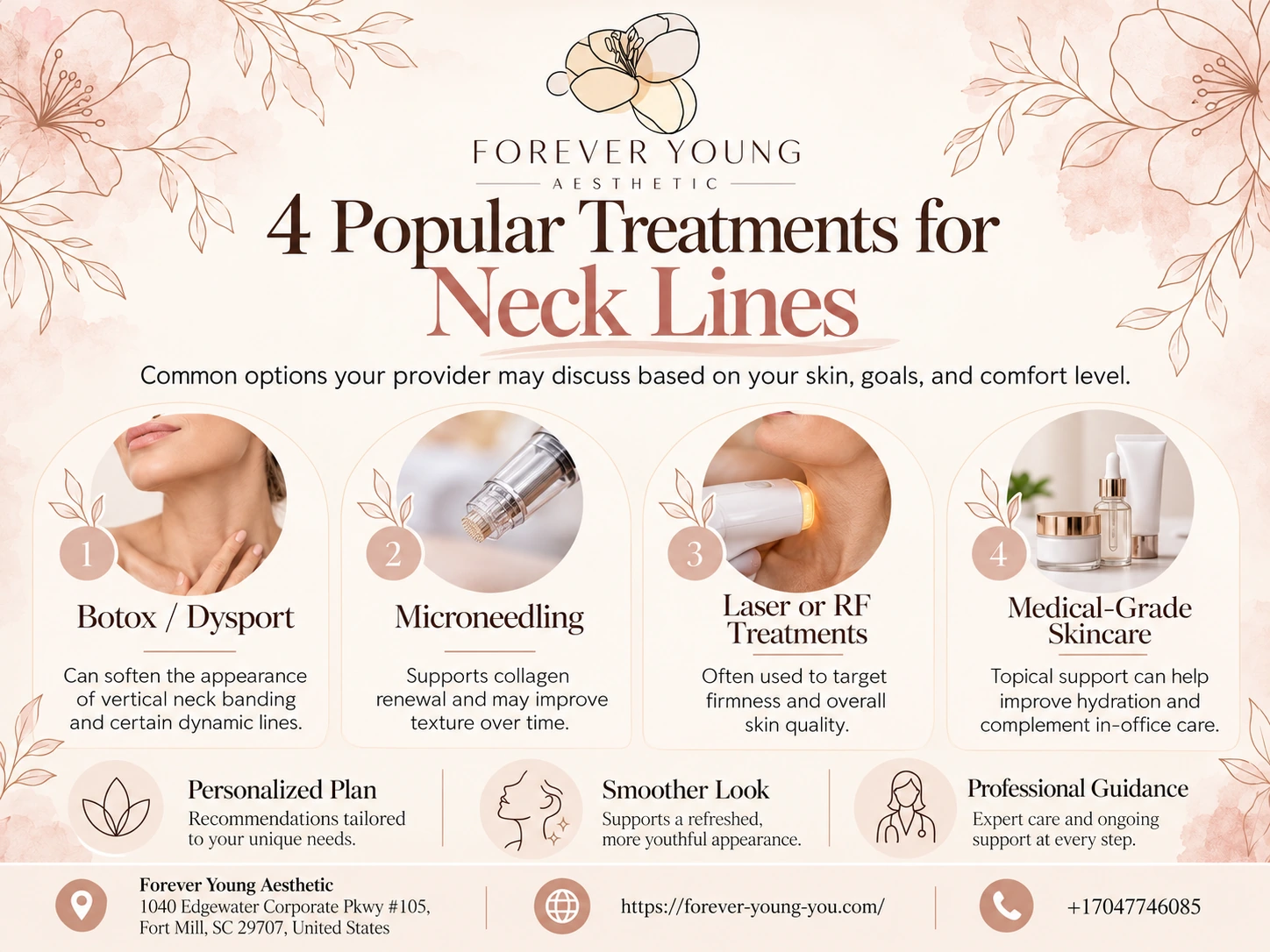
Possible treatment categories include:
- Neuromodulators such as Botox
- Microneedling
- Energy-based skin treatments
- Laser treatments
- Chemical resurfacing treatments
- Injectable treatments in appropriate patients
- Medical-grade skincare
- Combination treatment plans
Fine lines associated with poor skin texture may respond better to treatments that stimulate remodeling or resurfacing.
Deeper horizontal creases may require a different approach because improving skin quality alone may not completely soften an established fold.
A consultation allows the provider to examine the lines while the neck is resting and moving. This can reveal whether muscle movement, skin quality, or structural changes are contributing most strongly.
Can Botox Help With Neck Lines?
Botox can help certain types of neck lines, but it is not the answer to every neck concern.
Botox works by temporarily reducing activity in targeted muscles. This makes it particularly relevant when muscle contraction contributes to visible neck bands or wrinkles.
Cleveland Clinic lists both horizontal “necklace” creases and vertical neck bands among neck concerns that may be treated with neuromodulator injections. It also notes that Botox effects commonly last around three to four months, although duration varies between patients.
For prominent platysmal bands, carefully placed injections can reduce the muscle activity that makes those bands stand out.
Botox may also be considered for certain horizontal neck lines when repeated muscle activity contributes to their appearance. However, deeply etched lines caused primarily by collagen loss or laxity may not respond sufficiently to muscle relaxation alone.
Botox also does not remove excess skin.
That distinction is important. A patient with strong platysmal activity may require a different plan from someone whose main concern is thin, sun-damaged, crepey neck skin.
Because the neck contains muscles involved in important functions, injections in this area require careful assessment and technique. Treatment should be performed by an appropriately trained medical professional.
Which Skin Treatments Can Improve Neck Texture?
When the concern is fine lines, roughness, crepey skin, or photoaging, treatments that focus on skin quality may be more appropriate.
Options can vary depending on a patient’s skin type and treatment goals.
Microneedling
Microneedling creates controlled micro-injuries in the skin that trigger a healing response and stimulate remodeling.
It may be considered for fine lines, texture concerns, and early signs of skin aging.
Laser Treatments
Certain laser treatments can target texture, pigmentation, and signs of photoaging while encouraging skin remodeling.
The appropriate laser depends on skin type, severity of damage, desired downtime, and the specific concern being treated.
Energy-Based Treatments
Radiofrequency and other energy-based technologies may be used to stimulate collagen and improve the appearance of mild skin laxity or texture.
Different devices work at different depths, so treatment should be selected according to the patient’s anatomy and goals.
Chemical Peels
Some chemical peels can improve superficial pigmentation, roughness, and fine lines.
The neck can be more sensitive than certain areas of the face, so peel strength and application must be selected carefully.
Medical-Grade Skincare
Daily skincare cannot duplicate the effects of professional procedures, but it can play an important supporting role.
A routine may include appropriate moisturizers, antioxidants, retinoids when suitable, and consistent sunscreen.
Sun protection is particularly important because ongoing UV exposure can contribute to additional collagen damage and photoaging.
Can Microneedling Help Neck Lines?
Microneedling may help improve fine neck lines and overall skin texture by encouraging collagen remodeling.
A clinical study of microneedling for facial and neck skin found measurable changes associated with skin rejuvenation after a series of treatments. Another study specifically evaluating neck wrinkles reported improvement following microneedling treatments.
However, results vary.
Microneedling tends to make the most sense when concerns involve:
- Fine wrinkles
- Uneven texture
- Early crepey skin
- Mild photoaging
- Declining skin quality
It is less likely to completely correct significant loose skin or strong muscle bands.
Patients should also understand that collagen remodeling is gradual. The goal is usually progressive improvement rather than an immediate disappearance of lines.
Depending on the treatment plan, multiple sessions may be recommended.
Microneedling can also sometimes be combined with other treatments when both skin quality and another underlying factor need to be addressed.
When Are Combination Treatments More Effective?
Combination treatment can be useful because neck aging often involves more than one process.
For example, a patient may have:
- Visible platysmal bands from muscle activity
- Fine lines from collagen loss
- Sun-related pigmentation
- Mild skin laxity
- Deep horizontal creases
One treatment is unlikely to address every one of those concerns equally well.
A provider might therefore use one treatment to address muscle activity and another to improve skin quality.
For example, Botox may help soften muscle-related bands while microneedling or another skin treatment focuses on texture and collagen remodeling.
The American Academy of Dermatology notes that dermatologists often combine treatment approaches when addressing signs of skin aging because different procedures target different concerns.
Combination therapy does not necessarily mean performing everything at once.
Treatments may be staged over several appointments so the provider can assess the response before deciding what, if anything, should come next.
A thoughtful plan should use the fewest interventions needed to address the patient’s actual concerns rather than automatically adding procedures.
How Long Do Neck Line Treatment Results Last?
How long results last depends on the treatment used, your skin, and the underlying cause of the neck lines.
Botox
Neuromodulator results are temporary. Cleveland Clinic notes that Botox effects commonly last approximately three to four months, although individual duration varies.
Muscle activity gradually returns as the treatment wears off.
Microneedling
Microneedling stimulates a remodeling process rather than temporarily relaxing a muscle.
Improvements develop progressively, and maintenance treatments may be recommended because natural skin aging continues.
Resurfacing and Energy Treatments
Duration depends on the device, treatment intensity, number of sessions, skin condition, sun exposure, and ongoing skincare.
These treatments do not stop the aging process.
Skincare
Results from skincare depend heavily on consistency. Daily sun protection is especially important for limiting additional UV-related damage.
No cosmetic procedure permanently prevents new neck lines from developing. Aging, movement, gravity, genetics, and sun exposure continue over time.
Maintenance should therefore be discussed as part of the initial treatment plan rather than treated as an unexpected requirement later.
Which Neck Line Treatment Is Right for You?
The right treatment depends on what you actually want to improve.
Someone with strong vertical neck bands may be evaluated for a neuromodulator.
A patient whose primary concern is fine, crepey skin may benefit more from treatments designed to improve skin quality.
Another person may have deeply etched horizontal lines that require a different or combined approach.
During an assessment, a provider may look at:
- Whether lines are horizontal or vertical
- Whether lines appear at rest or only during movement
- Depth of the wrinkles
- Degree of skin laxity
- Skin thickness
- Sun damage
- Muscle activity
- Overall neck and jawline anatomy
- Previous cosmetic treatments
- Desired amount of change
- Comfort with downtime and maintenance
It is also important to establish realistic expectations.
Nonsurgical treatments can improve certain neck concerns, but they cannot reproduce the effects of surgery in someone with substantial excess or sagging skin. Cleveland Clinic similarly notes that nonsurgical options can enhance the neck’s appearance, while a surgical neck lift addresses excess skin and can tighten the platysma muscle.
Knowing what a treatment cannot accomplish is just as important as understanding what it can.
Why a Personalized Consultation Matters
Two patients can both ask for treatment for “neck wrinkles” while needing completely different approaches.
One may have dynamic platysmal bands. Another may have horizontal lines that have become permanently etched into the skin. A third may primarily have sun damage and crepey texture.
Treating all three in the same way would overlook the underlying cause.
At Forever Young Aesthetics, a personalized consultation allows us to evaluate your neck at rest and during movement, discuss what changes bother you most, and determine which treatment options are appropriate for your goals.
We can also explain:
- What each treatment is designed to improve
- What it is unlikely to change
- Whether multiple sessions may be needed
- Expected recovery or downtime
- How gradually results may appear
- Whether maintenance treatments may be appropriate
- When combining treatments may make sense
The goal should not simply be choosing the most popular neck treatment. It should be selecting an option that matches your anatomy, skin condition, and desired outcome.
FAQs
What is the most effective treatment for neck lines?
There is no single treatment that is most effective for everyone. The best option depends on whether your lines are caused primarily by muscle activity, skin aging, laxity, sun damage, or a combination of factors.
Can Botox get rid of horizontal neck lines?
Botox may soften certain horizontal neck lines when muscle activity contributes to them, but it may not completely correct deeply etched lines or significant skin laxity.
Does Botox help vertical neck bands?
It can. Botox may reduce the appearance of vertical platysmal bands by temporarily relaxing targeted muscle activity. A consultation is needed to determine whether it is appropriate.
Is microneedling good for neck wrinkles?
Microneedling can be considered for fine lines, crepey texture, and other signs of skin aging. Improvement typically develops gradually as the skin remodels rather than appearing immediately.
Can neck lines disappear completely?
Results depend on the depth and cause of the lines. Cosmetic treatments may soften their appearance, but complete removal cannot be guaranteed.
Can skincare improve neck lines?
Consistent skincare can support skin quality and help protect against additional sun damage. However, established or deep neck lines may require professional treatment for more noticeable improvement.
At what age should you treat neck lines?
There is no specific age. Treatment decisions should be based on the concern itself, your skin condition, and your goals rather than a number.
Find the Right Treatment for Your Neck Lines
The best treatments for neck lines are the ones chosen for the reason those lines are there. Botox may be useful when muscle activity plays a role, while microneedling and other skin-focused treatments may be more appropriate for fine wrinkles, texture changes, or collagen loss. Some patients may benefit from addressing more than one concern with a combination approach.
At Forever Young Aesthetics, we evaluate your skin, muscle activity, neck anatomy, and goals before recommending treatment. Schedule a personalized consultation to learn which options may be appropriate for your neck lines and the type of improvement you want to achieve.