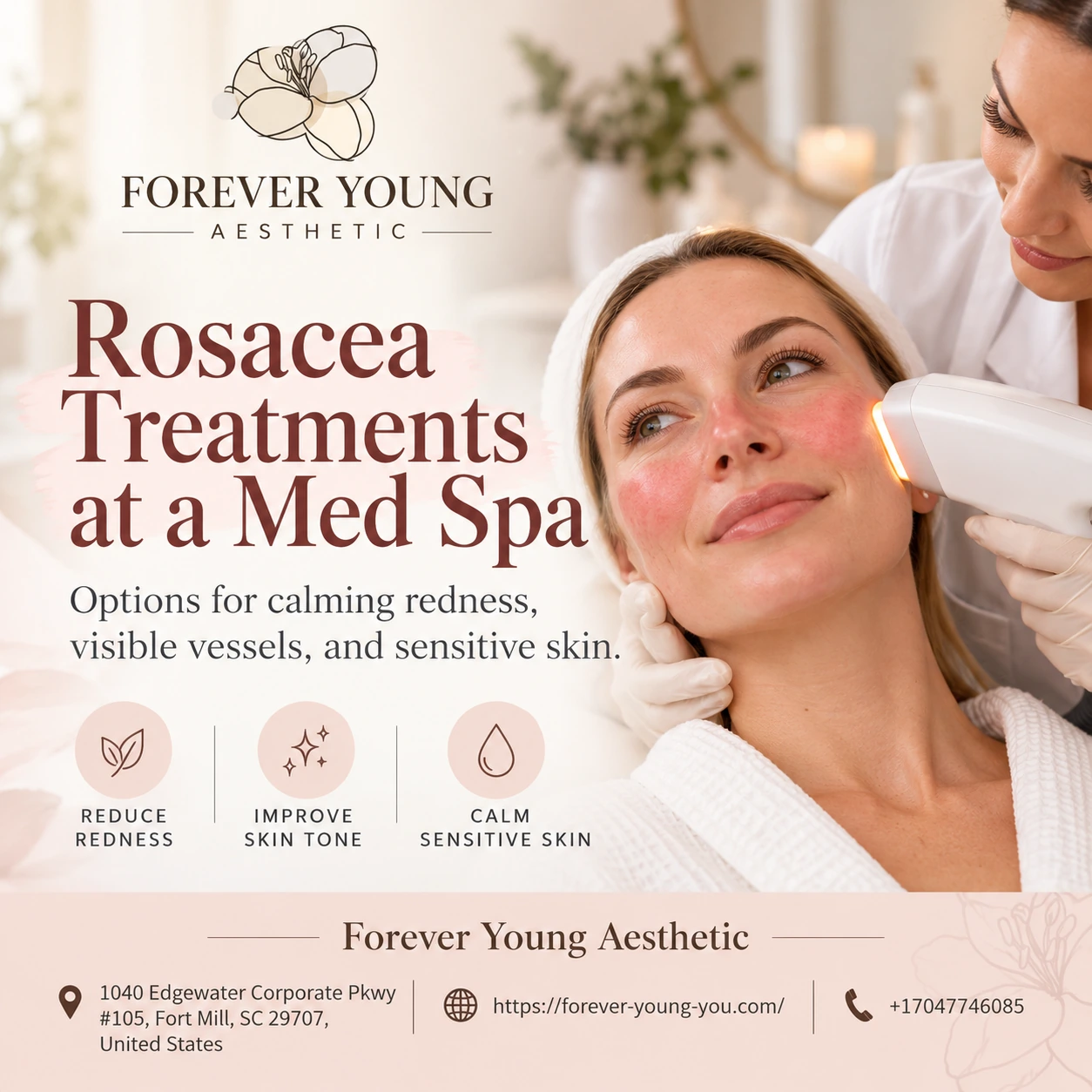
Rosacea treatments at a med spa may help reduce the appearance of persistent redness, visible facial blood vessels, and some texture concerns, but they do not cure rosacea. Laser and light-based treatments can be particularly useful for certain vascular symptoms, while gentle skincare and trigger management often remain important parts of controlling the condition.
The right approach depends on your symptoms, skin type, triggers, and whether rosacea has been medically diagnosed. At Forever Young Aesthetics, treatment should begin with determining whether a cosmetic procedure is appropriate or whether evaluation by a dermatologist or another medical professional would be a better first step.
What Is Rosacea?
Rosacea is a chronic inflammatory skin condition that most often affects the central face, including the cheeks, nose, forehead, and chin.
It commonly causes flushing or persistent facial color changes and may also produce visible blood vessels, sensitive skin, and acne-like bumps. Symptoms can improve for periods and then flare again.
Rosacea can appear differently depending on skin tone. On lighter skin, persistent redness may look pink or red. On darker skin, color changes may appear violet, brown, or more subtle, which can sometimes make rosacea harder to recognize.
Rosacea is not caused by poor hygiene, and it is not contagious.
Its exact cause remains unclear. Genetics, immune activity, vascular changes, environmental influences, and other factors may all contribute.
Most importantly, rosacea is a medical skin condition rather than simply cosmetic redness. Procedures can improve certain visible symptoms, but some patients also require prescription medication or ongoing dermatologist-directed management.
What Are the Most Common Signs of Rosacea?
Rosacea does not look exactly the same in every patient.
Some people primarily experience facial flushing and sensitivity, while others develop persistent redness, enlarged blood vessels, inflammatory bumps, or eye symptoms.
Common signs can include:
- Frequent facial flushing
- Persistent redness or color changes
- Small visible facial blood vessels
- Burning, stinging, or warmth
- Sensitive or easily irritated skin
- Acne-like bumps or pustules
- Facial swelling
- Dry or rough-feeling skin
- Eye irritation
- Thickening of the skin in more advanced cases
The American Academy of Dermatology also notes that rosacea can affect the eyes. Ocular rosacea may cause dryness, burning, itching, light sensitivity, redness, tearing, or a gritty sensation.
This variation matters when choosing treatment.
A procedure designed to reduce visible blood vessels will not necessarily treat inflammatory bumps. Similarly, a soothing facial cannot replace medical treatment when rosacea is causing significant inflammation or eye involvement.
Correctly identifying the symptoms being treated is therefore the first step.
Can a Med Spa Treat Rosacea?
A med spa may be able to help improve certain visible signs associated with rosacea, particularly facial redness and visible blood vessels.
Depending on the facility, available treatments may include vascular lasers, intense pulsed light, or carefully selected skin treatments designed to support sensitive skin.
However, cosmetic treatment should not be confused with curing rosacea.
There is currently no cure for rosacea. Treatment is focused on controlling symptoms, reducing flare-ups, improving comfort, and limiting progression. Medical treatment may include prescription topical or oral medications in addition to skincare, trigger management, and procedures.
For this reason, patients who have never received a diagnosis should not assume that any persistent facial redness is rosacea.
Several conditions can resemble it, including acne, dermatitis, allergic reactions, sun damage, and other inflammatory or vascular skin conditions.
When the diagnosis is uncertain, medical evaluation should come before cosmetic treatment.
Which Skin Treatments May Help Rosacea-Prone Skin?
Treatment needs to be selected carefully because rosacea-prone skin can be unusually sensitive.
More aggressive does not necessarily mean more effective.
Gentle, Barrier-Supportive Skincare
Supporting the skin barrier is an important part of rosacea management.
The American Academy of Dermatology recommends gentle cleansing, moisturizing, sun protection, and avoiding products that irritate the skin as part of a rosacea treatment plan.
Professional skin treatments for rosacea-prone patients should generally follow the same principle.
The goal may be to:
- Support hydration
- Reduce unnecessary irritation
- Maintain the skin barrier
- Calm dry or uncomfortable skin
- Introduce appropriate home-care products
Patients with highly reactive skin should tell their provider about previous reactions to skincare ingredients or cosmetic procedures.
Intense Pulsed Light
Intense pulsed light, commonly called IPL, uses broad-spectrum light rather than a single laser wavelength.
For selected rosacea patients, IPL may help reduce flushing, persistent facial color, and visible superficial blood vessels.
The AAD includes IPL among treatments dermatologists may use to improve flushing and skin texture in rosacea.
Several sessions may be needed, and IPL is not suitable for every skin type or every manifestation of rosacea.
Vascular Laser Treatments
Certain lasers specifically target blood vessels and may help reduce visible facial vessels and persistent vascular redness.
The device, settings, skin type, and operator’s experience all matter. Rosacea-prone skin should not be treated with a one-size-fits-all laser protocol.
What About Peels and Aggressive Resurfacing?
Patients with rosacea should be cautious with treatments that create substantial irritation.
Strong chemical peels, aggressive exfoliation, abrasive treatments, or intensive resurfacing may trigger symptoms in some people.
That does not mean every exfoliating treatment is automatically inappropriate. It means treatment needs to be selected according to the patient’s current skin condition and sensitivity.
Procedures should generally be postponed if the skin is actively inflamed or unusually irritated unless a qualified medical professional specifically recommends otherwise.
Can Laser Treatments Reduce Facial Redness?
Yes, certain laser and light treatments can reduce some forms of redness associated with rosacea, particularly when enlarged superficial blood vessels are responsible.
Vascular devices work by delivering energy that is absorbed by targeted blood vessels. The treated vessels are gradually cleared by the body, making them less visible.
According to the American Academy of Dermatology, laser and light therapy may be incorporated into rosacea treatment particularly when visible blood vessels are present. The AAD also notes that treatment can reduce persistent redness, although the degree of improvement varies.
This distinction is important.
Laser treatment may work particularly well for an individual visible vessel but does not necessarily eliminate every source of facial flushing.
Rosacea may continue to produce new blood vessels or episodes of redness over time because treatment does not eliminate the underlying tendency to develop the condition.
Results therefore should not be considered permanent protection against future rosacea symptoms.
Temporary effects after vascular treatment can include:
- Increased redness
- Swelling
- Tenderness
- Temporary darkening or discoloration
- Bruising or purplish spots with some treatments
More serious complications, including burns, scarring, and permanent pigment changes, are possible when laser or light treatment is used incorrectly. The AAD emphasizes the importance of appropriately trained medical professionals when these technologies are used for rosacea.
Who Is a Good Candidate for Rosacea Treatments?
Candidacy depends on both the symptoms and the treatment being considered.
Someone seeking laser or light treatment may be a reasonable candidate when the primary concerns include:
- Persistent facial redness
- Clearly visible facial blood vessels
- Recurrent vascular flushing
- Redness that remains after other rosacea symptoms are controlled
- Realistic expectations about gradual improvement and maintenance
A consultation should also consider:
- Skin tone and skin type
- Current level of inflammation
- History of pigment changes
- Previous laser treatments
- Medications
- History of cold sores
- Tendency to bruise
- Photosensitivity
- Current skincare products
- Previous reactions to procedures
- Personal rosacea triggers
Not every patient with facial redness should immediately undergo laser treatment.
If someone has active, painful inflammatory lesions, significant skin irritation, possible infection, eye symptoms, or an uncertain diagnosis, medical evaluation may be more appropriate before proceeding.
Good candidacy is therefore about more than simply having redness.
What Rosacea Triggers Should You Avoid Before Treatment?
Rosacea triggers vary considerably from person to person.
Commonly reported triggers include:
- Sun exposure
- Heat
- Hot baths and saunas
- Very hot or cold weather
- Spicy foods
- Hot beverages
- Alcohol
- Strenuous exercise
- Emotional stress
- Wind
- Certain skincare or cosmetic products
- Some medications that dilate blood vessels
Mayo Clinic lists sunlight, wind, temperature extremes, spicy foods, alcohol, hot drinks, exercise, stress, some medications, and certain personal-care products among possible rosacea triggers.
However, patients do not need to avoid every possible trigger simply because it appears on a list.
The National Rosacea Society emphasizes that triggers are individual. Something that causes flushing in one person may have no effect on another. Tracking personal flare patterns can therefore be more useful than following a highly restrictive universal list.
Before a med spa appointment, try to avoid your known triggers, particularly anything that reliably causes significant flushing or irritation.
It is also important to disclose medications, supplements, topical products, recent tanning or sun exposure, and previous cosmetic procedures before laser or light treatment.
Do not stop prescription medications simply because you have a cosmetic procedure scheduled unless the healthcare professional managing those medications advises you to do so.
What Should You Expect After Treatment?
Recovery depends on what type of treatment was performed.
After a vascular laser or light treatment, temporary redness and swelling can occur. Some people may develop bruising or small reddish-purple areas depending on the specific device and settings used.
The AAD notes that redness following laser or light treatment can sometimes persist for days and, in some cases, longer. Temporary purple or red spots may also occur following certain treatments.
Your provider should give you individualized aftercare instructions.
These may include recommendations to:
- Keep skincare gentle
- Use moisturizer as directed
- Avoid scratching or rubbing the area
- Avoid irritating active ingredients temporarily
- Limit excessive heat
- Avoid strenuous exercise for a recommended period
- Protect the skin carefully from sunlight
- Use broad-spectrum sunscreen
Sun protection is particularly important after laser and light treatment because recently treated skin may be more vulnerable to unwanted pigment changes and other complications.
Do not judge your final result immediately.
Redness or swelling directly after treatment can temporarily make the area look worse before it improves. Multiple sessions may also be recommended depending on the type and extent of the vascular changes.
When Should You See a Dermatologist Instead?
Med spa treatments are primarily useful for selected cosmetic manifestations of rosacea. Some symptoms require medical diagnosis or management.
Consider seeing a dermatologist or another appropriate healthcare professional if:
You Have Never Been Diagnosed
Facial redness has many possible causes.
If you do not know whether you actually have rosacea, obtaining a diagnosis before pursuing repeated cosmetic treatments can prevent ineffective or inappropriate treatment.
You Have Persistent Bumps or Pustules
Acne-like rosacea may require prescription topical or oral medication rather than a purely cosmetic procedure.
Your Symptoms Are Getting Worse
Increasing redness, persistent inflammation, frequent painful flares, or symptoms that are difficult to control deserve medical evaluation.
Your Eyes Are Affected
Eye symptoms require particular attention.
Dryness, burning, redness, light sensitivity, gritty sensations, swollen eyelids, or changes in vision can occur with ocular rosacea. The AAD advises medical treatment when rosacea affects the eyes, with ophthalmology referral sometimes appropriate.
Vision changes or significant eye pain should not be treated as a cosmetic concern.
The Skin Is Becoming Thickened
Rosacea can occasionally cause progressive skin thickening, particularly around the nose. This is called phymatous rosacea, and thickening of the nose is known as rhinophyma.
It requires medical assessment and may need specialized treatment.
Your Diagnosis Is Uncertain
If redness appeared suddenly, has an unusual pattern, or does not behave like typical rosacea, a dermatologist can assess whether another skin condition is responsible.
Cosmetic treatment should not substitute for establishing the correct diagnosis.
How to Choose the Right Rosacea Treatment Approach
The best treatment approach starts with identifying which features of rosacea bother you most.
Someone whose main concern is visible facial vessels may benefit from a vascular laser or light-based procedure.
Someone with predominantly inflammatory bumps may need medical treatment.
Another patient may have extremely sensitive, dry skin and need to focus first on restoring the skin barrier and identifying triggers.
Many people have several concerns at once.
When developing a treatment plan, consider:
- Persistent redness versus temporary flushing
- Visible blood vessels
- Inflammatory bumps
- Skin sensitivity
- Dryness or barrier disruption
- Eye symptoms
- Skin tone
- Personal triggers
- Previous treatments
- Current medications
- Desired improvement
- Comfort with downtime
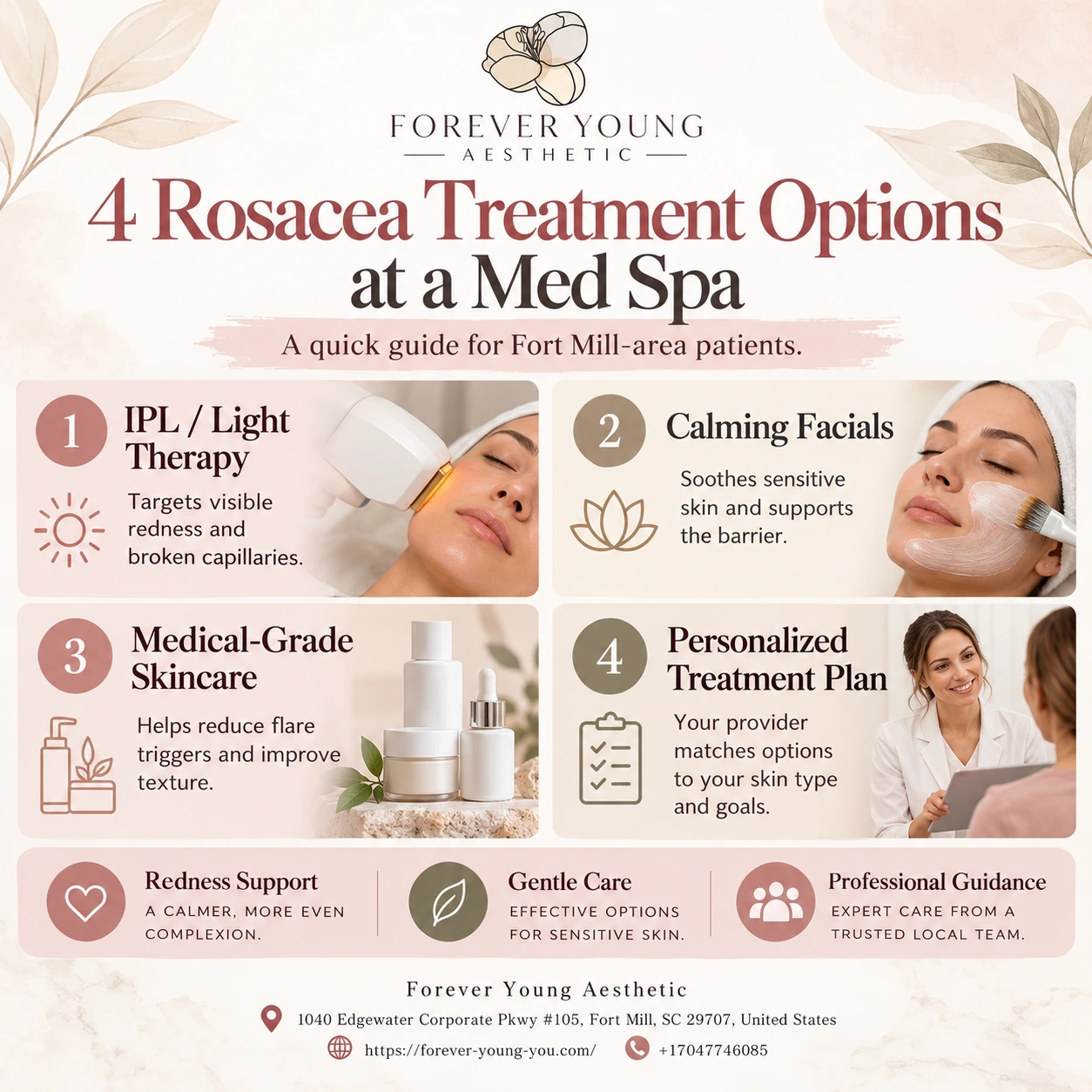
Combination treatment is common because rosacea can involve several different symptoms. The National Rosacea Society notes that management may include topical or oral medication, laser or light therapy, gentle skincare, and trigger avoidance depending on the individual’s particular signs and symptoms.
That does not mean everyone needs every treatment.
At Forever Young Aesthetics, the goal should be to identify which cosmetic concerns can reasonably be addressed within a med spa setting and recognize when medical evaluation should come first.
FAQs
Can a med spa get rid of rosacea?
No. Rosacea is a chronic skin condition without a known cure. Med spa procedures may reduce visible redness, blood vessels, or other cosmetic concerns, but symptoms can return and ongoing management may be needed.
What is the best med spa treatment for rosacea?
There is no single best treatment. Vascular lasers or IPL may help redness and visible vessels, while other patients may need gentle skin treatments, prescription medication, or a combination approach.
Does IPL help rosacea?
IPL may reduce flushing, persistent redness, and visible blood vessels in appropriately selected patients. Results vary, and multiple sessions may be necessary.
Can laser treatment permanently remove rosacea?
Laser treatment can reduce treated blood vessels, but it does not cure the underlying condition. New vessels and redness may develop in the future.
Can facials make rosacea worse?
Aggressive products, excessive heat, friction, or irritating ingredients may trigger some rosacea-prone skin. Treatments should be adjusted for sensitivity and avoided when the skin is significantly inflamed unless medically advised.
Should you exfoliate if you have rosacea?
Rosacea-prone skin can be sensitive to exfoliation. Avoid aggressive scrubs or strong exfoliating treatments without professional guidance. A gentle skincare routine is often better tolerated.
How many laser treatments are needed for rosacea?
The number varies according to the device, severity of visible vessels or redness, skin type, and individual response. A provider should assess your skin before estimating a treatment course.
Can rosacea come back after treatment?
Yes. Procedures can improve visible symptoms, but they do not eliminate the underlying tendency toward rosacea. Trigger management, appropriate skincare, sun protection, medical treatment when necessary, and maintenance procedures may all play a role.
Find the Right Approach for Rosacea-Prone Skin
Rosacea treatments at a med spa can help address certain visible concerns, particularly facial redness and enlarged superficial blood vessels. Laser and light-based procedures may be useful for some patients, while gentle skincare and trigger management can support sensitive skin. However, cosmetic treatment is only one part of rosacea care and should not be presented as a cure.
At Forever Young Aesthetics, we consider your redness, visible vessels, sensitivity, skin type, and treatment goals before recommending a cosmetic approach. If your symptoms suggest that diagnosis, prescription treatment, or specialized medical care is needed, seeing a dermatologist or another appropriate medical professional may be the better next step.