

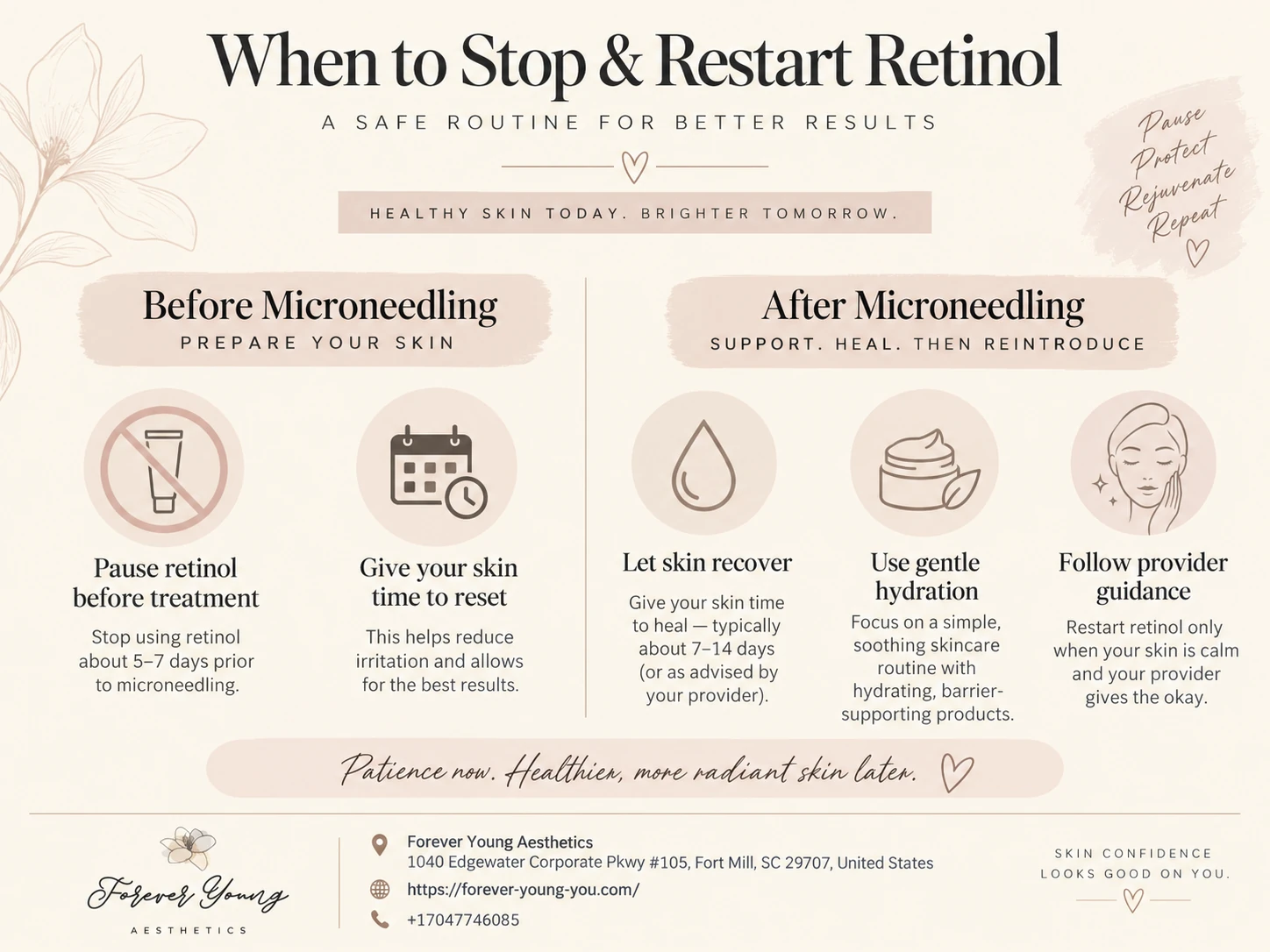
Retinol is often paused before microneedling because it can make the skin more sensitive, dry, or reactive. It may also need to stay out of your routine for a period after treatment while the skin barrier recovers. The exact timing depends on your retinol strength, skin sensitivity, treatment depth, and your provider’s instructions.
At Forever Young Aesthetic, we recommend following a personalized pre- and post-treatment skincare plan rather than relying on a universal schedule. Giving your skin enough time to recover can help reduce irritation and support a smoother healing process.
Can You Use Retinol Before Microneedling?
Retinol may need to be stopped before microneedling, especially if you use it frequently or if your skin becomes dry, flaky, or sensitive from it.
Microneedling works by creating controlled micro-injuries in the skin. These tiny channels stimulate a natural healing response and are commonly used to improve concerns such as:
- Uneven texture
- Fine lines
- Acne scarring
- Enlarged-looking pores
- Certain forms of discoloration
- Overall skin quality
Because retinol can increase skin turnover and sometimes cause irritation, continuing to use it too close to treatment may leave the skin more reactive than your provider would prefer.
That does not mean retinol is unsafe in general.
It means the timing around a procedure matters.
Your provider may recommend temporarily pausing retinol so your skin arrives at the appointment calm, intact, and free from unnecessary irritation.
Why Retinol May Need to Be Paused Before Treatment
Retinol and other retinoids can be effective skincare ingredients, but they may also cause temporary side effects such as:
- Dryness
- Peeling
- Redness
- Tightness
- Increased sensitivity
- Stinging
- Irritation
These effects are especially common when someone has recently started retinol, increased the strength, or uses it too frequently.
Microneedling already creates a temporary inflammatory response in the skin.
If the skin is irritated before treatment, the procedure may feel more uncomfortable and recovery may be less predictable.
Pausing retinol beforehand may help reduce the chance of entering treatment with a compromised skin barrier.
Your provider may also ask about prescription retinoids, exfoliating acids, acne medications, and other active skincare products because these can affect how your skin responds.
How Long Before Microneedling Should You Stop Retinol?
There is no single stop date that is appropriate for everyone.
Some providers may recommend pausing retinol for several days before treatment, while others may recommend a longer interval depending on the product and the condition of your skin.
Factors that can affect the recommendation include:
- Whether you use over-the-counter retinol or a prescription retinoid
- Product strength
- How often you use it
- Whether your skin is currently peeling or irritated
- Your history of sensitivity
- The depth of the planned microneedling treatment
- Other active skincare products you are using
- Whether additional treatments are being performed at the same time
For example, someone using a mild retinol once or twice per week may receive different instructions from someone using a stronger prescription retinoid every night.
The safest approach is to tell your provider exactly what product you use and how often you apply it.
Do not assume that a schedule you found online automatically applies to your skin.
When Can You Restart Retinol After Microneedling?
Retinol should generally not be restarted while the skin is still visibly irritated, tender, peeling, or unusually sensitive.
After microneedling, the skin barrier needs time to recover.
Your provider may recommend waiting until the skin has returned closer to its normal condition before reintroducing retinol.
Signs that your skin may still be in active recovery include:
- Redness
- Warmth
- Tightness
- Flaking
- Dry patches
- Stinging when applying basic moisturizer
- Increased sensitivity to products
- Persistent tenderness
Even if your skin looks better after a few days, deeper layers may still be recovering.
That is why your provider’s timeline matters.
When retinol is eventually restarted, some people may also be advised to reintroduce it gradually rather than immediately returning to their previous frequency.
What Happens If You Use Retinol Too Soon After Treatment?
Using retinol before the skin has adequately recovered may increase irritation.
Because the skin barrier is temporarily more vulnerable after microneedling, products that were normally well tolerated may suddenly feel much stronger.
Possible reactions can include:
- Burning
- Stinging
- Increased redness
- Excessive dryness
- Peeling
- Tightness
- Prolonged irritation
- Increased sensitivity
In some cases, excessive irritation can make the recovery period more uncomfortable.
It may also make it difficult to tell whether symptoms are part of normal healing or are caused by a skincare product.
If you accidentally use retinol soon after treatment and your skin becomes irritated, stop using the product and contact your provider for guidance.
Avoid trying to “fix” the irritation by adding more active ingredients.
A simple, gentle skincare routine is usually more appropriate during recovery.
What Skincare Products Are Best During Recovery?
Post-microneedling skincare should usually be simple.
The goal is to support the skin barrier while minimizing unnecessary irritation.
Your provider may recommend products such as:
Gentle Cleanser
Use a mild cleanser that removes oil and debris without stripping the skin.
Avoid aggressive scrubbing.
Simple Moisturizer
A bland, fragrance-free moisturizer can help reduce dryness and support the skin barrier.
Look for formulas designed for sensitive or recovering skin.
Hydrating Products
Depending on your provider’s recommendations, gentle hydrating ingredients may be appropriate during recovery.
The emphasis should be on hydration rather than aggressive treatment.
Sunscreen
Sun protection is especially important after microneedling.
Freshly treated skin may be more vulnerable to ultraviolet exposure, which can contribute to irritation and unwanted pigmentation changes.
Your provider may recommend a broad-spectrum sunscreen suitable for sensitive skin.
Ingredients to Avoid After Microneedling
Retinol is not the only ingredient that may need to be temporarily avoided.
Your provider may recommend pausing other products that could irritate the skin during recovery.
These can include:
- Prescription retinoids
- Retinol
- Retinal
- Glycolic acid
- Lactic acid
- Salicylic acid
- Strong exfoliating toners
- Physical scrubs
- Benzoyl peroxide
- Certain highly concentrated vitamin C formulas
- Fragranced products
- Strong acne treatments
You may also be advised to avoid at-home exfoliation tools or treatments.
The exact list depends on your normal routine and treatment plan.
Do not automatically assume that “natural” products are gentle enough for freshly treated skin. Botanical extracts, essential oils, and fragranced products can still cause irritation.
How to Protect Your Skin While It Heals
Skincare products are only one part of microneedling recovery.
How you treat your skin during the first several days can also affect comfort and irritation.
Avoid Picking or Peeling
If mild flaking develops, allow it to shed naturally.
Picking can further irritate the skin.
Limit Excessive Heat
Your provider may advise temporarily avoiding activities that create significant heat or sweating, such as:
- Saunas
- Steam rooms
- Hot tubs
- Very hot showers
- Intense workouts
Follow the specific recommendations you receive after treatment.
Protect Your Skin From the Sun
Sun exposure should be minimized while the skin is recovering.
Wear sunscreen as directed and consider additional protection such as a hat when outdoors.
Keep Your Routine Simple
Recovery is not the ideal time to experiment with new active ingredients.
Stick with the products recommended by your provider until your normal routine can be gradually resumed.
Keep the Skin Hydrated
Dryness and tightness can be common after treatment.
Using an appropriate moisturizer can help support comfort while the skin barrier recovers.
Why Your Retinol Timeline May Vary
One person’s retinol timeline should not automatically be copied by someone else.
Several factors can change how long retinol needs to be paused.
Retinol Strength
A low-strength over-the-counter product may affect the skin differently from a prescription-strength retinoid.
Frequency of Use
Someone using retinol once per week may respond differently from someone applying it every evening.
Skin Type and Sensitivity
Sensitive, dry, or reactive skin may require a more cautious approach.
Microneedling Intensity
Microneedling treatments can vary in depth and intensity.
A more intensive treatment may require a longer recovery period before active products are restarted.
Additional Treatments
If microneedling is combined with another aesthetic procedure, post-treatment instructions may be different.
Existing Skin Conditions
Acne, eczema, rosacea, irritation, or other skin concerns may affect recommendations.
Previous Treatment Response
How your skin responded to earlier microneedling sessions can also help guide future aftercare.
Personalization matters because there is a significant difference between skin that looks completely calm and skin that remains red, flaky, or sensitive.
When to Ask Your Provider About Restarting Retinol
Contact your provider if you are uncertain whether your skin is ready.
It is especially important to ask before restarting retinol if:
- Redness is lasting longer than expected
- Your skin feels unusually sensitive
- Moisturizer still stings
- You have significant peeling
- You developed a rash
- You are using a prescription retinoid
- You use retinol for acne treatment
- You recently increased your retinol strength
- You had a more intensive microneedling treatment
- You are combining microneedling with other aesthetic procedures
You should also contact your provider if you experience symptoms that seem more severe than the normal recovery they described.
Post-treatment guidance should be based on how your individual skin is healing rather than on a rigid calendar.
Follow a Personalized Microneedling Skincare Plan With Forever Young Aesthetic
Retinol can be an important part of a long-term skincare routine, but timing matters when microneedling is involved.
Pausing retinol before treatment may help minimize unnecessary sensitivity, while waiting until the skin has adequately recovered before restarting can help reduce dryness, burning, peeling, and irritation.
At Forever Young Aesthetic, we help patients understand how their existing skincare routine fits around aesthetic treatments. Retinol strength, skin type, treatment intensity, sensitivity, and other active ingredients can all influence the appropriate pre- and post-treatment plan.
Rather than following a generic timeline, ask your provider exactly when to stop and restart your products.
If you are considering microneedling or have questions about combining retinol with your treatment plan, contact Forever Young Aesthetic for personalized guidance based on your skin and aesthetic goals.
FAQs
Do I have to stop retinol before microneedling?
Many providers recommend temporarily stopping retinol or retinoid products before microneedling because they may increase dryness and sensitivity. However, the appropriate timing depends on your product, skin condition, frequency of use, and planned treatment. Follow the instructions provided specifically for you.
How many days after microneedling can I use retinol?
There is no universal number of days that applies to everyone. Retinol is generally not restarted while the skin remains red, tender, peeling, dry, or sensitive. Your provider can tell you when your skin has recovered enough to resume active products.
Can retinol make microneedling irritation worse?
It can. Retinol may increase dryness, peeling, stinging, and sensitivity, particularly when used too close to treatment or too soon during recovery. Temporarily pausing it may reduce unnecessary irritation.
What should I use instead of retinol after microneedling?
Your routine will usually focus on gentle cleansing, hydration, moisturizer, and sun protection during early recovery. Use the specific products recommended by your treatment provider and avoid introducing new active ingredients while your skin is healing.
Can I use exfoliating acids after microneedling?
Exfoliating acids such as glycolic, lactic, and salicylic acid may be too irritating during early recovery. Your provider may recommend temporarily avoiding them along with retinol and other strong active ingredients.
What if I accidentally use retinol after microneedling?
If your skin feels normal, do not panic, but stop using the retinol until you have followed up with your provider. If you develop significant burning, redness, swelling, peeling, or another unexpected reaction, contact your provider for personalized advice.
Is prescription tretinoin treated differently from retinol?
Potentially. Prescription tretinoin is generally more potent than many over-the-counter retinol products, so your provider may recommend different pre- and post-treatment instructions. Always tell your microneedling provider about prescription skincare medications before treatment.