
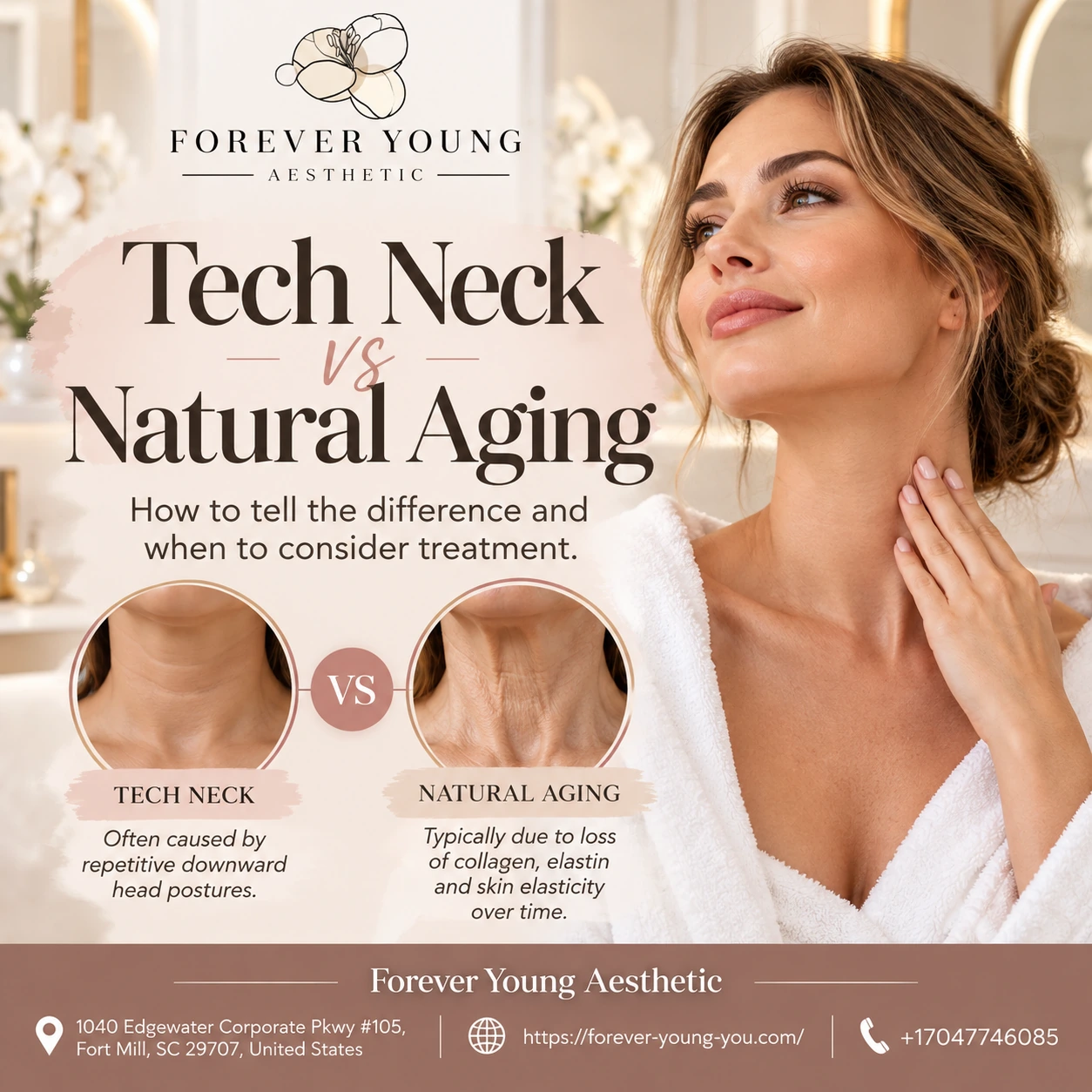
Tech neck and natural aging can both contribute to lines, creases, and changes in the appearance of the neck, but they are not the same thing. Tech neck is associated with repeated forward bending of the neck during activities such as looking at phones, tablets, or laptops, while natural aging involves gradual changes in collagen, elasticity, skin thickness, and underlying tissues.
In many people, the two overlap. Repeated neck movement may make existing horizontal creases more noticeable, while aging and sun exposure can make the skin less able to recover from repeated folding. Understanding the difference can help determine whether prevention, skincare, injectable treatments, laser treatments, or another approach may be appropriate.
What Is Tech Neck?
“Tech neck” is a commonly used term for problems associated with frequently looking downward at phones, tablets, computers, and other screens.
From a musculoskeletal standpoint, prolonged forward-head posture can place additional strain on the muscles and structures of the neck and shoulders. Cleveland Clinic describes tech neck as a repetitive-use problem associated with sustained forward head positioning during screen use.
From a cosmetic perspective, the term is also sometimes used to describe horizontal lines that appear or become more noticeable across the front of the neck.
When you repeatedly look downward, the skin naturally folds along certain areas of the neck. Over time, these repeated creases may become more noticeable, particularly when the skin is also experiencing age-related changes in elasticity.
However, screen use should not automatically be blamed for every horizontal neck line.
Some people develop visible neck creases at a young age because of their anatomy, genetics, skin characteristics, and the natural way their neck folds. Others may develop more prominent lines as aging, sun exposure, and repeated movement combine.
For that reason, “tech neck” is better understood as a possible contributing factor rather than a diagnosis explaining every neck wrinkle.
How Does Natural Aging Affect the Neck?
Natural aging affects several layers of the neck.
As skin ages, it gradually becomes thinner, drier, and less elastic. Collagen and supportive tissues also decline, making lines and folds more likely to remain visible instead of smoothing when the neck returns to a neutral position. Mayo Clinic identifies declining elasticity, collagen, and deeper facial fat as contributors to wrinkles and sagging skin with age.
The neck may be particularly noticeable because its skin is relatively thin and is constantly moving.
Age-related changes can include:
- Fine lines
- Deeper horizontal creases
- Crepey skin
- Uneven texture
- Skin laxity
- Vertical neck bands
- Changes along the jawline
- Sun-related pigmentation
Muscle activity can also affect the appearance of the aging neck.
The platysma is a broad, thin muscle extending across the neck. Over time, its activity may contribute to visible vertical bands in some patients.
Natural aging therefore involves much more than repeated bending of the neck. It affects the quality, structure, elasticity, and support of the skin itself.
Tech Neck vs Natural Aging: What Is the Difference?
The primary difference between tech neck and natural aging is what contributes most strongly to the visible changes.
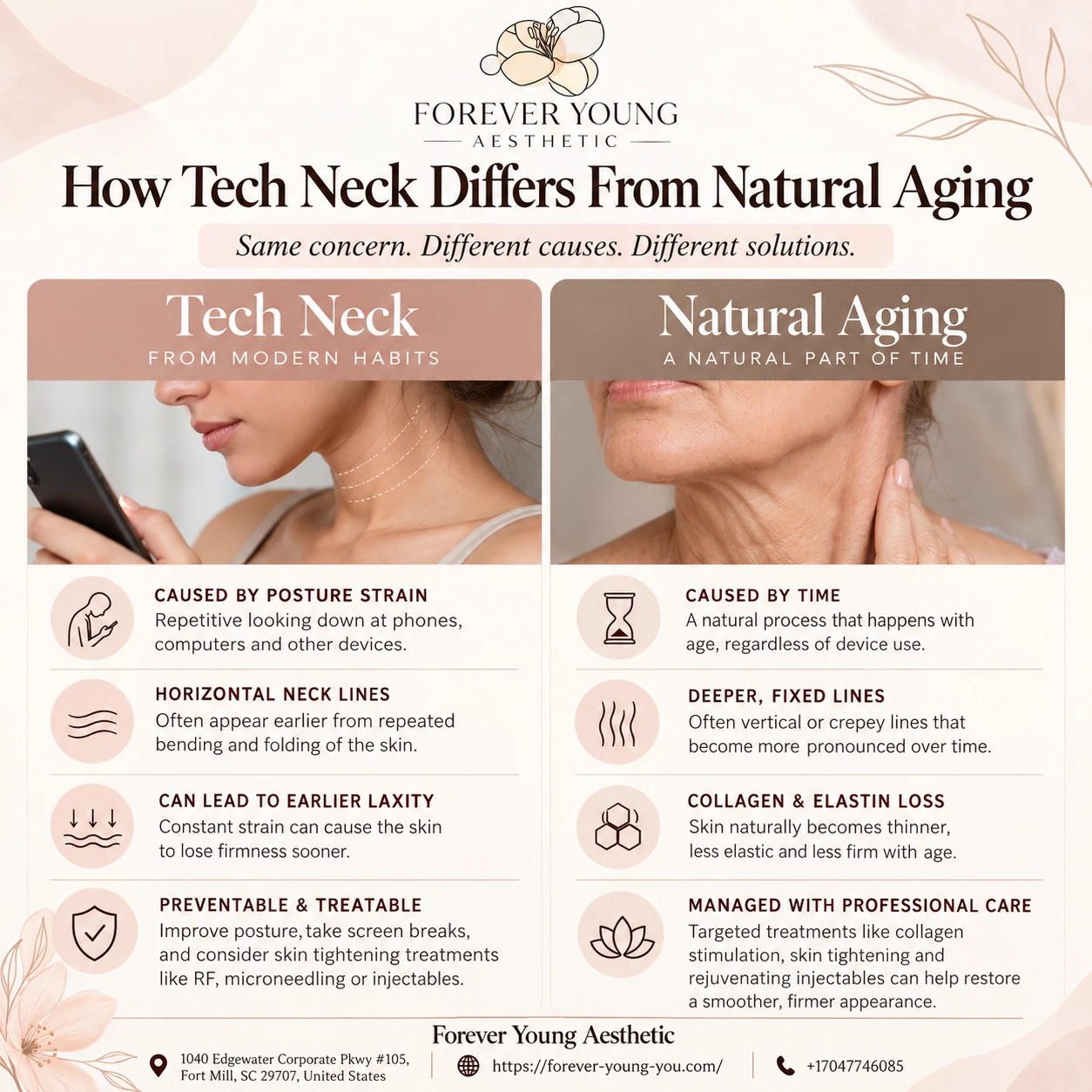
Tech neck is associated with repetitive posture and movement. Looking downward repeatedly causes the skin of the neck to fold in similar places again and again.
Natural aging is associated with changes in the skin and supporting tissues. Collagen declines, elasticity decreases, skin may become thinner, and laxity can develop.
The two processes can also reinforce each other.
Younger skin tends to recover from folding more easily because it has greater elasticity. As the skin ages, the same repeated movement may leave a crease that remains noticeable for longer.
A simple comparison looks like this:
| Tech Neck | Natural Aging |
| Associated with repeated neck flexion | Develops gradually over time |
| May emphasize horizontal folds | Can cause horizontal and vertical changes |
| Frequently linked with prolonged screen posture | Related to collagen loss, elasticity changes, and tissue aging |
| Can occur in younger adults | Becomes more common with increasing age |
| Posture changes may reduce repeated folding | Cannot be prevented entirely |
| May overlap with existing anatomical neck lines | Often includes laxity, texture changes, and sun damage |
Importantly, seeing horizontal lines does not prove that someone spends too much time looking at a phone.
A provider needs to examine the skin, muscle movement, and structure of the neck before deciding what is contributing to the concern.
What Causes Horizontal Neck Lines?
Horizontal neck lines develop for several reasons.
Repetitive Folding
Every time you bend your neck forward, the skin folds.
Repeated movement can cause the same areas to crease repeatedly. Similar processes occur elsewhere on the body where skin regularly bends or folds.
Natural Anatomy
Some people simply have more visible neck creases because of the structure of their neck and the way their skin folds.
These lines can be present long before significant skin aging occurs.
Collagen and Elastin Loss
Collagen gives skin structure, while elastin helps it return to its original shape.
As these supportive components decline, temporary folds may become more persistent.
Sun Exposure
Ultraviolet radiation damages collagen and elastin and accelerates visible skin aging. Mayo Clinic notes that UV exposure contributes to the breakdown of these supportive fibers, leading to reduced strength and flexibility.
Genetics
Genetics influence skin thickness, elasticity, pigmentation, and how the neck ages.
Two people with similar screen habits may therefore develop very different levels of neck wrinkling.
Skin Laxity
Loose skin can deepen existing folds and create additional creases.
This becomes increasingly relevant as aging progresses.
Because horizontal neck lines have several possible causes, simply correcting posture may not completely remove established creases.
Can Screen Time Make Neck Lines Worse?
Potentially, but the relationship should not be oversimplified.
The concern is less about the screen itself and more about the position you maintain while using it.
Looking downward for long periods repeatedly flexes the neck. Cleveland Clinic notes that sustained forward-head posture during device use places greater strain on the neck and surrounding muscles.
From a cosmetic standpoint, that same position also repeatedly folds the skin across the front of the neck.
If those movements happen for hours every day, they may contribute to more noticeable horizontal creasing, especially in skin that is already losing elasticity.
However, screen time is only one possible factor.
Someone who rarely uses a smartphone can still develop horizontal neck lines because of:
- Normal movement
- Genetics
- Natural anatomy
- Aging
- Sun exposure
- Collagen loss
- Skin laxity
Reducing prolonged downward posture may help limit repetitive folding, but it cannot prevent all forms of neck aging.
How Do Sun Exposure and Collagen Loss Affect the Neck?
Sun exposure is one of the most important external contributors to visible skin aging.
Ultraviolet radiation gradually damages collagen and elastin. As this damage accumulates, the skin can develop wrinkles, looseness, uneven pigmentation, and changes in texture. The American Academy of Dermatology describes wrinkles and loose skin among the visible effects of long-term UV-related photoaging.
The neck is sometimes overlooked during sunscreen application.
People may carefully protect their forehead, cheeks, and nose while stopping at the jawline. Over many years, that difference in sun protection can become noticeable.
Collagen loss also occurs naturally with age.
As structural support decreases, neck skin may become less resilient. A crease that once disappeared immediately after changing position can eventually remain visible at rest.
This is one reason why repetitive movement and natural aging often become difficult to separate. Movement creates the fold, while reduced skin resilience may make that fold more permanent.
Daily broad-spectrum sunscreen, protective clothing, and avoiding unnecessary UV exposure can help reduce further photoaging. Mayo Clinic recommends broad-spectrum SPF 30 or higher as part of protecting aging skin from additional sun damage.
Can Tech Neck Be Prevented?
You cannot eliminate every neck line, but you can reduce unnecessary periods of prolonged forward-head posture.
Practical habits include:
Raise Your Screen
Whenever possible, bring your phone or computer closer to eye level instead of repeatedly lowering your head toward the device.
For computer work, position the monitor so you can look primarily forward rather than continuously downward.
Change Positions Regularly
Remaining in one posture for long periods can contribute to discomfort and repetitive strain.
Cleveland Clinic recommends changing position regularly rather than trying to maintain one supposedly perfect posture all day.
Take Screen Breaks
Short, regular breaks give your neck an opportunity to move through a different range of motion.
This can be particularly useful if you spend most of the workday at a computer.
Support Your Neck and Shoulders
An ergonomic workspace can reduce the tendency to lean forward.
Keep your monitor aligned with your body and avoid placing commonly used screens far below eye level.
Protect Your Neck From the Sun
Apply sunscreen beyond the jawline and onto exposed areas of the neck.
Sun protection will not stop movement-related folding, but it can help limit the UV damage that makes skin less resilient over time.
Maintain a Consistent Skincare Routine
Moisturizers can support the skin barrier and temporarily make fine lines less noticeable.
Other skincare ingredients, such as retinoids when appropriate, may be considered as part of an individualized skin-aging routine.
Prevention is most helpful before deep lines become established. Once a crease is clearly visible at rest, changing posture alone is unlikely to erase it.
Which Skin Treatments May Help Neck Lines?
The right treatment depends on whether the primary concern is a horizontal crease, rough texture, collagen loss, sun damage, muscle activity, laxity, or several factors together.
Potential treatment categories include:
Microneedling
Microneedling creates controlled micro-injuries that stimulate the skin’s repair and remodeling response.
It may be considered for fine lines, mild textural changes, and early signs of collagen loss.
Results generally develop gradually rather than immediately.
Neuromodulators
Treatments such as Botox work by temporarily reducing targeted muscle activity.
They may be useful when certain neck lines or vertical platysmal bands are influenced by muscle contraction.
However, Botox does not replace lost collagen or remove significant loose skin.
Injectable Treatments
Certain injectable approaches may be considered for selected horizontal neck lines when structural support or an etched crease is a concern.
Suitability depends on anatomy, skin thickness, the depth of the line, and the specific product being considered.
Chemical Treatments
Carefully selected chemical peels may improve superficial texture, pigmentation, or fine lines.
The neck can respond differently from facial skin, so treatment strength needs to be selected appropriately.
Medical-Grade Skincare
Skincare can support professional treatments and help protect the skin from additional damage.
Sunscreen, moisturizers, antioxidants, and appropriately selected active ingredients may all play a role.
No single treatment is appropriate for every patient with tech neck or age-related neck lines.
Can Laser Treatments Improve Neck Texture?
Certain laser treatments can improve aspects of neck texture and photoaging.
Depending on the technology, lasers may be used to target:
- Fine lines
- Uneven pigmentation
- Rough texture
- Sun damage
- Collagen remodeling
The American Academy of Dermatology includes laser resurfacing among treatments dermatologists may use for visible sun damage and skin aging.
However, laser treatment must be selected carefully for the neck.
The appropriate device and intensity depend on factors such as skin type, pigmentation, degree of sun damage, desired downtime, and treatment goals.
Laser treatment also has limitations.
It may improve surface texture and stimulate remodeling, but it cannot completely correct every deeply etched neck crease or significant excess skin.
Some patients may benefit more from another treatment or a combination of approaches.
How to Choose the Right Treatment Approach
Choosing treatment starts with identifying what is actually causing the concern.
A provider may evaluate:
- Whether the lines are horizontal or vertical
- Whether they appear only during movement or remain visible at rest
- Skin thickness and texture
- Degree of laxity
- Sun damage
- Pigmentation
- Muscle activity
- Depth of individual creases
- Overall neck anatomy
- Previous treatments
- Desired amount of improvement
- Acceptable downtime
For example, a younger patient with superficial horizontal creases and good skin elasticity may need a very different plan from someone with deeper lines, significant photoaging, and loose skin.
Someone with prominent vertical platysmal bands may also require a different treatment from someone whose main concern is crepey skin.
Combination treatment may sometimes make sense because one procedure cannot address every layer of neck aging.
A patient might use one treatment to improve texture and collagen remodeling while another addresses muscle activity. Treatments can also be staged rather than performed simultaneously.
At Forever Young Aesthetics, treatment planning should be based on the neck you have now, not simply on whether the lines are labeled “tech neck.”
FAQs
Is tech neck the same as normal neck wrinkles?
Not exactly. Tech neck generally refers to changes associated with repeated forward neck posture and screen use. Normal neck wrinkles can also develop because of aging, genetics, sun exposure, collagen loss, and natural skin folding.
Can young people get tech neck lines?
Yes. Horizontal neck lines can appear in younger adults, particularly when anatomy and repeated folding make them noticeable. Their presence does not necessarily mean the skin is prematurely aging.
Will looking down at my phone permanently wrinkle my neck?
Looking down repeatedly can contribute to skin folding, but phone use is not the only cause of neck wrinkles. Genetics, collagen loss, UV exposure, anatomy, and natural aging also matter.
Can improving my posture get rid of neck lines?
Better posture may reduce repetitive folding and neck strain, but it is unlikely to completely erase established lines that remain visible at rest.
Does sunscreen help prevent neck wrinkles?
Sun protection can help reduce UV-related collagen and elastin damage, which contributes to premature wrinkles, skin laxity, and other signs of photoaging.
Can microneedling help tech neck?
Microneedling may help when fine lines and reduced skin quality are contributing to the appearance of the neck. It will not correct every cause of horizontal creases.
Are lasers good for tech neck?
Certain laser treatments may improve texture, fine lines, pigmentation, and sun damage. Whether a laser is appropriate depends on your skin type, the nature of the lines, and your treatment goals.
Is Botox used for tech neck?
Botox may be considered when muscle activity contributes to neck lines or vertical platysmal bands. It does not directly replace lost collagen or remove excess skin.
Understand What Is Causing Your Neck Lines
Tech neck and natural aging often overlap, which is why horizontal neck lines cannot always be blamed on screen time alone. Repetitive neck movement may contribute to folding, while collagen loss, sun exposure, genetics, skin laxity, and normal aging can make those creases increasingly visible.
At Forever Young Aesthetics, we evaluate the type of neck lines you have, your skin quality, muscle activity, and your goals before recommending treatment. A personalized consultation can help determine whether skincare, microneedling, laser treatment, injectables, or a combination approach may be appropriate for the changes you want to address.