

Sleeping after Botox is generally safe once you have followed the immediate aftercare instructions provided by your injector. Many providers recommend remaining upright for the first few hours and avoiding pressure, rubbing, or massage around treated areas during the early recovery period.
After that initial window, most people can sleep comfortably without significantly changing their routine. However, recommendations can vary depending on where you were treated, so the instructions from your provider at Forever Young Aesthetics should always take priority.
Can You Sleep After Botox?
Yes. Botox does not require you to stay awake for the entire day or night after treatment.
The main consideration is when you lie down after your injections. Many medical providers advise staying upright for several hours immediately after treatment. Mayo Clinic recommends avoiding lying down for approximately two to four hours, while Cleveland Clinic advises remaining upright for around three to four hours.
If your treatment is scheduled earlier in the day, this usually means your normal bedtime will fall well outside that precautionary period.
Your injector may give you slightly different instructions based on:
- The areas treated
- The amount of Botox used
- Your medical history
- Other procedures performed during the appointment
- Your individual treatment plan
Follow those instructions even if they differ from general recommendations you have read online.
How Long Should You Stay Upright After Botox?
A commonly recommended timeframe is approximately three to four hours after treatment, although recommendations can vary.
Remaining upright during this initial period is traditionally advised to reduce unnecessary pressure on the injection sites while the treatment begins settling into the targeted muscles. Cleveland Clinic recommends staying upright for three to four hours after Botox, while Mayo Clinic gives a range of two to four hours.
You do not need to stand during this time. Sitting normally at a desk, eating a meal, watching television, or completing other light activities is generally compatible with staying upright.
If you feel tired, try relaxing in a chair rather than lying flat until the timeframe recommended by your provider has passed.
Scheduling your appointment several hours before your usual bedtime can also make this easier.
Can You Sleep on Your Side After Botox?
Side sleeping is generally less concerning once the initial upright period recommended by your provider has passed.
There is limited evidence showing that simply sleeping on your side later that night will significantly alter a properly administered Botox treatment. The more practical concern immediately after injections is avoiding unnecessary pressure, rubbing, or massage around the treated areas.
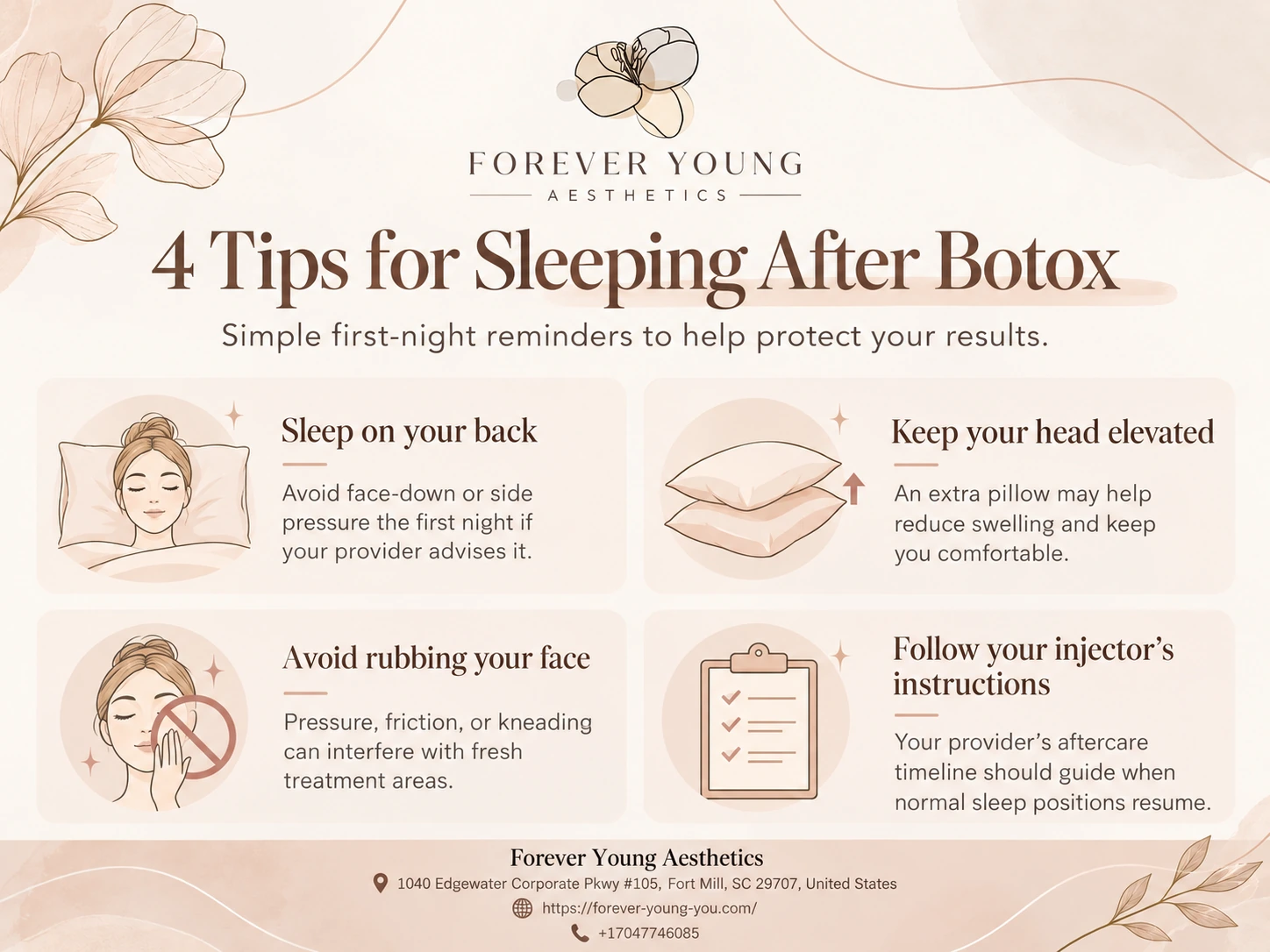
If Botox was injected around the forehead, temples, crow’s feet, or another area that could press directly against your pillow, you may prefer to sleep on your back the first night for comfort and reassurance.
However, if you naturally roll onto your side while asleep, there is usually no reason to panic. Do not aggressively massage the area or attempt to manipulate the Botox afterward. Continue following the aftercare instructions provided by your injector.
Can You Sleep on Your Stomach After Botox?
It may be helpful to avoid stomach sleeping during the first night, particularly if this position puts your face directly against the pillow.
Stomach sleeping can create more sustained facial pressure than sleeping on your back. It may also increase the chance that you unintentionally rub your forehead, eye area, or other treatment sites against bedding.
The concern is greatest during the first several hours following treatment.
Once the initial recovery period has passed, there is not strong evidence that normal sleeping positions alone will determine whether Botox works correctly. Still, patients who can comfortably sleep on their backs for the first night may find it easier to avoid unnecessary pressure.
If sleeping on your stomach is your only comfortable option because of another medical or physical concern, discuss it with your provider rather than sacrificing a full night’s sleep based on a general rule.
What Is the Best Sleeping Position the First Night?
Sleeping on your back with your head in a comfortable, neutral position is often the simplest option during the first night after Botox.
Back sleeping minimizes direct contact between your face and the pillow. It may be particularly useful if you received injections in areas such as the:
- Forehead
- Glabella between the eyebrows
- Crow’s feet area
- Upper face
- Jaw or lower face
You do not necessarily need to sleep sitting upright all night. Once you have completed the upright period recommended by your injector, lying down is generally acceptable.
If back sleeping is uncomfortable, additional pillows can sometimes help prevent you from immediately rolling over. The goal is comfort and avoiding significant pressure, not forcing yourself into an unnatural position all night.
A good night’s sleep is important too.
Why Should You Avoid Pressure on Treated Areas?
After Botox injections, the treated areas may have small injection points and temporary tenderness, redness, swelling, or bruising.
For this reason, providers commonly advise avoiding aggressive rubbing or massage shortly after treatment. Cleveland Clinic recommends avoiding pressure on treated areas for approximately 12 hours and avoiding rubbing the injection sites. Mayo Clinic similarly advises against rubbing or massaging treated areas for 24 hours.
That does not mean your face cannot touch anything.
Normal, gentle contact is different from repeatedly pressing, rubbing, massaging, or manipulating an injection site.
During the first night, try to avoid:
- Firmly massaging your forehead or face
- Using facial massage tools
- Pressing treated areas hard into a pillow
- Rubbing areas that feel itchy or tender
- Applying significant pressure while cleansing your face
If you need to wash your face, follow your provider’s instructions and use gentle movements around injection points.
Can Sleeping Position Affect Botox Results?
Sleeping position is unlikely to be the main factor determining your Botox results, particularly after the first several hours have passed.
There are many warnings online claiming that one wrong sleeping position will cause Botox to migrate throughout the face. That concern is often overstated.
Botox is injected strategically into specific muscles by a trained provider. Cleveland Clinic notes that many Botox aftercare restrictions are precautionary and that unwanted outcomes are more commonly related to injection technique than to a patient making a minor mistake afterward.
That does not mean aftercare should be ignored.
Avoiding rubbing, massage, heavy pressure, and lying down immediately after treatment remains a sensible precaution. But accidentally turning onto your side during the night does not automatically mean your treatment has been compromised.
If something unusual develops, contact your injector rather than trying to correct it yourself.
What Other First-Night Aftercare Tips Should You Follow?
Your provider will give you personalized instructions after treatment. In general, the first night should be simple and low-key.
Do Not Rub or Massage the Area
Avoid vigorous rubbing, massage, facial rollers, gua sha tools, and similar pressure over freshly treated areas.
Keep Exercise Light
Some providers recommend avoiding strenuous exercise for the remainder of the day or for approximately 24 hours. Cleveland Clinic advises avoiding physical exertion for 24 hours following Botox treatment.
Follow the specific activity restrictions given by your injector.
Be Gentle With Skincare
You can ask your provider when to resume your complete skincare routine, especially if it includes exfoliating acids, retinoids, scrubs, facial devices, or products that require vigorous application.
Avoid Manipulating Small Bumps
Tiny raised areas can sometimes be visible temporarily at injection sites. Avoid repeatedly touching or pressing them.
Be Careful With Bruising
Bruising can occur after injectable treatments. Certain medications may increase bruising risk, but do not stop prescribed blood thinners or other medications unless the healthcare professional who manages them tells you to do so.
Follow the Instructions You Were Given
Aftercare recommendations can differ based on injection sites and treatment plans. Personalized instructions from the professional who performed your treatment should take priority over general online advice.
When Can You Return to Your Normal Sleep Routine?
Many patients can return to their usual sleeping position after the first night, and some may be able to do so sooner once the initial upright period has passed.
There is no universal rule requiring everyone to sleep on their back for several nights after Botox.
Your provider might recommend additional precautions if:
- You received injections in an unusual treatment area
- You combined Botox with another cosmetic procedure
- You have significant swelling or bruising
- You previously experienced complications
- Your individual treatment plan requires different aftercare
If your injector specifically tells you to avoid a particular sleeping position for longer, follow that recommendation.
Otherwise, normal sleep can usually resume relatively quickly.
When Should You Contact Your Provider?
Mild redness, tenderness, swelling, bruising, or a temporary headache may occur after Botox injections. Botox Cosmetic’s official safety information also lists possible effects such as injection-site discomfort, headache, eyelid or eyebrow drooping, dry eyes, swelling of the eyelids, blurred vision, and double vision.
Contact your provider if you experience an unexpected symptom, if an injection site appears to be worsening rather than improving, or if you are simply unsure whether something you are experiencing is normal.
More serious reactions require prompt medical attention. Official Botox Cosmetic safety information advises getting medical help immediately for symptoms including difficulty swallowing, speaking, or breathing. Effects associated with unintended spread of botulinum toxin can occur hours to weeks after treatment.
Other concerning symptoms may include significant generalized muscle weakness or notable changes in vision.
When in doubt, contact your healthcare provider rather than trying to diagnose a reaction based on information online.
FAQs
How long after Botox can I lie down?
Many providers recommend remaining upright for approximately three to four hours, while some guidance gives a range of two to four hours. Follow the timeframe your injector gives you.
What happens if I accidentally lie down after Botox?
Do not panic. Briefly lying down does not automatically mean your Botox will move or your results will be affected. Return upright if you are still within your provider’s recommended timeframe and avoid rubbing or pressing the treatment areas.
Do I have to sleep on my back after Botox?
Not necessarily. Back sleeping can minimize facial pressure during the first night, but it is not a universal requirement for every Botox patient. Follow your provider’s recommendations.
What if I roll onto my side while sleeping after Botox?
Accidentally turning onto your side later in the night does not automatically compromise your treatment. Avoid rubbing or massaging the treated area and continue with your normal aftercare instructions.
Do I need to sleep elevated after Botox?
Most patients do not need to remain elevated throughout the entire night once their recommended upright period has passed. Your provider may give different advice depending on your treatment.
How long should I avoid pressure on my face after Botox?
Recommendations vary. Cleveland Clinic advises avoiding pressure on treated areas for about 12 hours, while Mayo Clinic recommends avoiding rubbing or massage for 24 hours. Follow the instructions given after your specific treatment.
Feel Comfortable After Your Botox Treatment
Sleeping after Botox does not need to be complicated. The most important steps are generally to stay upright for the period recommended by your injector, avoid rubbing or applying significant pressure to treated areas, and follow the personalized aftercare instructions you receive.
At Forever Young Aesthetics, we want patients to understand both their treatment and their recovery. If you have questions about sleeping positions, exercise, skincare, or anything else after Botox, contact our team for guidance based on your specific treatment.